Executive Summary
Density is the bridge between milliliters and kilograms. Without it, no accurate conversion is possible because mL measures volume while kg measures mass. The formula kg = (mL x density in g/mL) / 1,000 works for every substance on Earth, from cooking oil to industrial chemicals. For water, density sits close to 1.00 g/mL, making 1,000 mL roughly equal to 1 kg. For honey, the same volume weighs about 1.42 kg. For olive oil, it drops to 0.92 kg. Temperature, dissolved substances, and liquid purity all shift density values. In this article, you will learn exactly how density governs every mL to kg conversion, see worked examples for common liquids, and discover the costly mistakes that happen when density is ignored. For instant results, try our mL to kg calculator with built-in density data for dozens of substances.
What Is Density and Why Is It Important?
Density is one of those concepts that sounds academic until you realize it controls nearly every volume-to-mass conversion you will ever perform. Understanding density is not optional when you need accurate results. It is the mathematical key that unlocks the relationship between how much space a substance fills and how much it actually weighs.
What Does Density Measure?
Density measures how much mass is packed into a given volume. Expressed as grams per milliliter (g/mL) or kilograms per liter (kg/L), it tells you the concentration of matter within a substance. Imagine filling two identical bottles with honey and olive oil. Both bottles hold 500 mL, but the honey bottle feels noticeably heavier. That weight difference comes from density. Honey has a density of approximately 1.42 g/mL, meaning each milliliter contains 1.42 grams of matter. Olive oil sits around 0.92 g/mL, packing less mass into every milliliter. If you have used our guide on finding liquid density, you already know how to look up or calculate this value for any substance.
How Density Connects Mass and Volume
Mass and volume describe fundamentally different properties. Volume tells you how much three-dimensional space an object or liquid occupies. Mass tells you how much matter that object contains. Density is the ratio that ties them together. When you know the density of a substance, you can move freely between volume and mass calculations. Without density, you are stuck with an incomplete equation. One side has a number in milliliters and the other side demands an answer in kilograms. Density fills the gap in between.
Why Density Is Needed to Convert mL to kg
Every mL to kg conversion is really two questions wrapped into one. First, how many grams does this volume of liquid contain? Second, how many kilograms do those grams represent? Density answers the first question directly. By multiplying volume in mL by density in g/mL, you get mass in grams. Dividing by 1,000 converts grams to kilograms. Skip the density step and you are making an assumption. Usually, the assumption is that density equals 1.00 g/mL, which only holds true for water at room temperature.
Density: The Bridge Between Volume and Mass
Why Can't mL Be Directly Converted to kg?
This is the question that trips up more people than any other in measurement science. The short answer: milliliters and kilograms measure completely different physical properties. Trying to convert between them directly is like converting minutes into meters. You need a rate, a ratio, or a connecting factor to bridge two different dimensions.
mL Measures Volume
A milliliter quantifies three-dimensional space. One milliliter equals one cubic centimeter. When you fill a graduated cylinder to the 250 mL mark, you are defining a space, not a weight. That space could hold water, mercury, air, or nothing at all. The milliliter count stays the same regardless of what fills it.
kg Measures Mass
A kilogram quantifies the amount of matter in an object. When a kitchen scale reads 2.5 kg, it is reporting how much stuff sits on the platform. A kilogram of feathers and a kilogram of lead contain the same amount of mass. They just occupy vastly different volumes. The kilogram does not care about shape or space. It only cares about matter content.
Density Connects Volume and Mass
Because these two units describe different physical dimensions, a direct conversion factor between them does not exist as a universal constant. Instead, the connection depends entirely on the substance involved. That substance-specific connection is density. For a deeper look at how volume and mass relate through density, explore our step-by-step mL to kg conversion guide.
How Does Density Affect mL to kg Conversion?
Density is not just a number you plug into a formula. It fundamentally changes the outcome of every conversion. Two containers holding the exact same volume of liquid can produce wildly different mass readings on a scale. The difference comes down to density alone.
How Higher Density Increases Mass
When a liquid has a density greater than 1.00 g/mL, each milliliter contains more than one gram of mass. Honey (1.42 g/mL), corn syrup (1.37 g/mL), and mercury (13.53 g/mL) are common examples. For these substances, the kilogram result will always exceed the simple volume-divided-by-1,000 shortcut. Five hundred milliliters of honey yields 0.71 kg, not 0.50 kg. That 42% difference matters in recipes, shipping, and industrial processes.
How Lower Density Decreases Mass
When density falls below 1.00 g/mL, each milliliter contains less than one gram. Vegetable oil (0.91 g/mL), ethanol (0.789 g/mL), and gasoline (0.75 g/mL) fit this category. Five hundred milliliters of vegetable oil weighs only 0.455 kg. Assume water density and you overestimate the mass by roughly 10%. In pharmaceutical manufacturing, that 10% error could mean a failed batch.
Why the Same Volume Can Have Different Masses
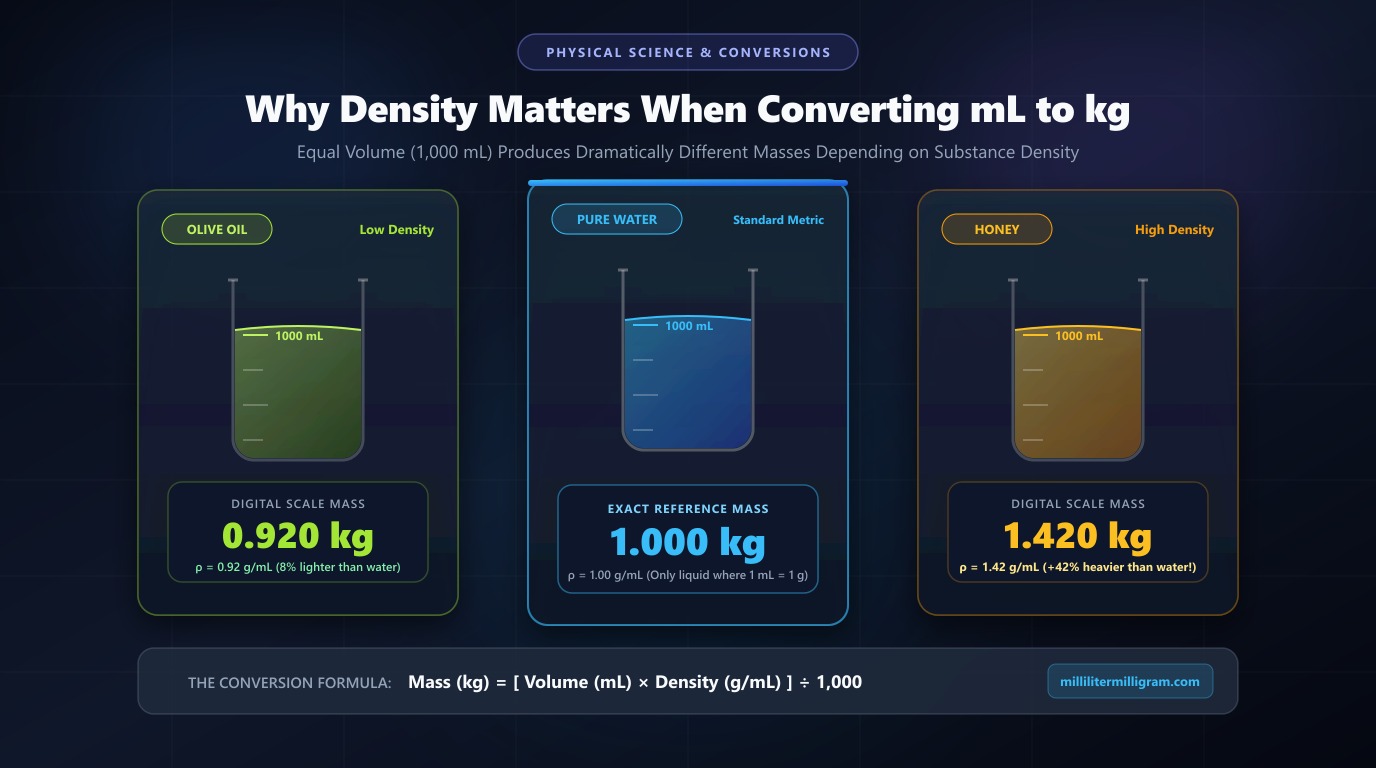
This is the core insight that makes density essential. Picture three identical 1-liter containers sitting on a shelf. One holds water, one holds honey, and one holds olive oil. Each container occupies the same space. Each holds exactly 1,000 mL. But place them on a scale one at a time and you get three different readings: approximately 1.00 kg for water, 1.42 kg for honey, and 0.92 kg for olive oil. The volume is constant. The mass changes because density changes.
Density Impact: 1,000 mL of Three Liquids on a Scale
How Is Density Used in the mL to kg Formula?
The formula itself is refreshingly simple. The challenge is not math. The challenge is using the correct density value in the correct unit. Once you have that, the rest takes seconds.
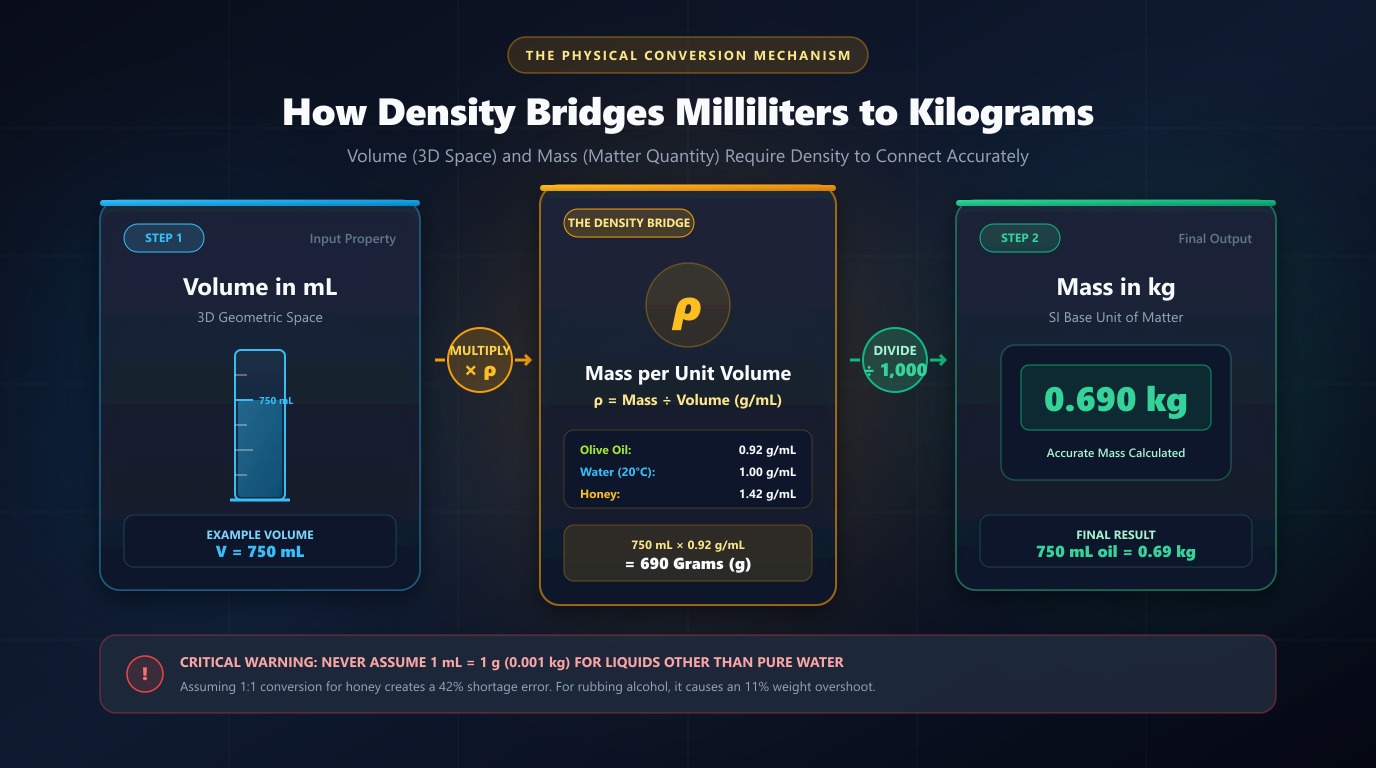
The Density Bridge: Volume in mL is multiplied by density (g/mL) to calculate mass in grams, then divided by 1,000 for kilograms.
The Relationship Between Volume, Density, and Mass
Mass equals volume multiplied by density. This is the foundational equation of every volume-to-mass conversion in physics and chemistry. When volume is in milliliters and density is in grams per milliliter, the result is mass in grams. One more step, dividing by 1,000, converts grams into kilograms.
Using Density in g/mL
Most reference tables list density in grams per milliliter. When you use g/mL directly, multiply volume in mL by density to get grams, then divide by 1,000 for kilograms. Example: 250 mL of milk (density 1.03 g/mL) = 250 x 1.03 = 257.5 g = 0.2575 kg.
Using Density in kg/L
Some scientific sources express density in kilograms per liter. Numerically, kg/L equals g/mL, so 1.03 g/mL is the same as 1.03 kg/L. When your volume is in liters, simply multiply: 0.25 L x 1.03 kg/L = 0.2575 kg. When your volume is in milliliters, convert to liters first by dividing by 1,000, or use the g/mL version of the formula.
Converting Density Units Before Calculating
Occasionally you encounter density in kg/m3 (kilograms per cubic meter). Water has a density of 998 kg/m3 at 20 degrees C. To convert kg/m3 to g/mL, divide by 1,000. So 998 kg/m3 becomes 0.998 g/mL. Always check your units before calculating. Mixing density units produces results that are off by factors of 1,000 or more.
Formula Pipeline: mL to Grams to Kilograms
How Does Water Density Affect mL to kg Conversion?
Water is the reason the myth "1,000 mL equals 1 kg" exists. It is a convenient approximation that happens to be true for one substance and one substance only. Understanding why this works for water, and why it fails for everything else, is essential to accurate measurement.
Why 1,000 mL of Water Is About 1 kg
Water at approximately 4 degrees Celsius has a density of 1.000 g/mL. At typical room temperature (20 degrees C), its density is 0.998 g/mL. That is close enough to 1.00 for most practical purposes. So 1,000 mL of water multiplied by 1.00 g/mL gives 1,000 g, which equals exactly 1 kg. This convenient relationship was not accidental. The kilogram was historically defined based on the mass of one liter of water.
Why the 1 mL to 1 g Relationship Applies to Water
The metric system was designed with water as its reference substance. One milliliter of pure water was intended to have a mass of exactly one gram. While modern precision measurements reveal slight deviations (0.998 g at 20 degrees C instead of 1.000 g), the relationship holds well enough for cooking, general chemistry, and everyday use. This is why people instinctively treat mL and grams as interchangeable. For water alone, they nearly are.
Why This Rule Should Not Be Applied to Every Liquid
The danger arises when people extend this water-specific shortcut to other substances. Honey packed into a 1-liter container weighs about 1,420 g (1.42 kg), not 1,000 g. Ethanol in the same container weighs only 789 g (0.789 kg). Applying the water rule universally introduces errors ranging from 5% to over 40% depending on the liquid. In laboratory work, pharmaceutical dosing, or industrial quality control, those errors have real consequences. Our article on why density matters for mL to mg conversions explains how this same principle applies to smaller units.
The Water Rule: Works for Water, Fails for Everything Else
How Does Density Change the Result for Different Liquids?
Real-world liquids span a broad range of densities. Seeing the numbers side by side reveals just how much the final kilogram value can shift based on the substance you are measuring.
Water
Density: 1.00 g/mL. One liter produces 1.00 kg. This is the baseline that all other conversions are compared against. Water is the only common liquid where the simple 1,000 mL = 1 kg rule holds approximately true.
Milk
Density: 1.03 g/mL. One liter produces 1.03 kg. Milk is slightly denser than water due to dissolved proteins, fats, and lactose. The difference is small (3%) but relevant in commercial dairy processing where batches run to thousands of liters.
Olive Oil
Density: 0.92 g/mL. One liter produces 0.92 kg. Olive oil is lighter than water, which is why it floats on top. In cooking, assuming olive oil weighs the same as water introduces an 8% error in your recipe mass calculations.
Vegetable Oil
Density: 0.91 g/mL. One liter produces 0.91 kg. Similar to olive oil but slightly lighter. This 9% mass reduction compared to water matters when scaling recipes or calculating shipping weights for bulk orders.
Honey
Density: 1.42 g/mL. One liter produces 1.42 kg. Honey is dramatically denser than water because it is a supersaturated sugar solution. Assuming water density for honey creates a 42% error, which is large enough to ruin any recipe, cost calculation, or scientific measurement.
Density and Mass Comparison for Common Liquids (1,000 mL)
| Liquid | Density (g/mL) | Mass of 1,000 mL (kg) | Error vs. Water Rule |
|---|---|---|---|
| Water | 1.00 | 1.000 kg | 0% |
| Whole Milk | 1.03 | 1.030 kg | +3% |
| Olive Oil | 0.92 | 0.920 kg | -8% |
| Vegetable Oil | 0.91 | 0.910 kg | -9% |
| Honey | 1.42 | 1.420 kg | +42% |
| Ethanol | 0.789 | 0.789 kg | -21.1% |
What Happens When Two Liquids Have Different Densities?
Comparing two liquids side by side makes the role of density impossible to ignore. Equal volumes do not produce equal masses. The density gap between substances determines exactly how large the mass gap will be.
Comparing Equal Volumes of Different Liquids
Take 500 mL of water and 500 mL of honey. Water produces 500 g (0.50 kg). Honey produces 710 g (0.71 kg). Same volume. Same measurement tool. A 42% difference in mass. That is entirely because honey packs 1.42 grams of matter into each milliliter while water packs only 1.00 gram.
Higher-Density Liquids vs. Lower-Density Liquids
Higher-density liquids always produce more kilograms for the same milliliter count. Lower-density liquids always produce fewer kilograms. This relationship is linear and predictable. If you double the density, you double the mass for any given volume. If you halve the density, you halve the mass.
Comparing Mass at the Same Volume
At 500 mL, ethanol weighs 0.395 kg, water weighs 0.500 kg, milk weighs 0.515 kg, and mercury weighs 6.765 kg. Mercury is over 17 times heavier than ethanol at the same volume. This range demonstrates why assuming a single conversion factor for all liquids is fundamentally wrong.
Why Does Liquid Density Change?
Density is not a perfectly fixed value. It shifts based on real-world conditions. Understanding these factors helps you choose the right density value for your specific situation.
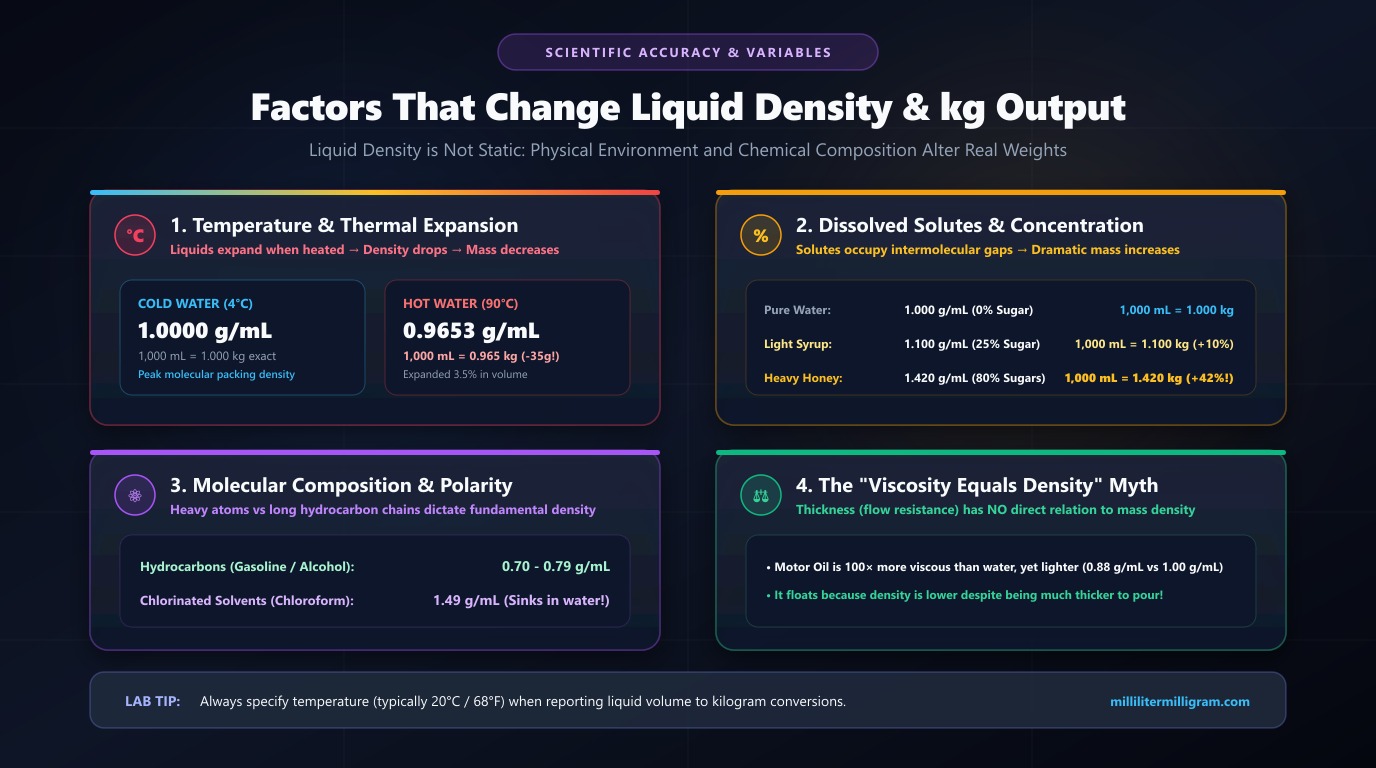
Environmental and chemical factors: Thermal expansion, dissolved solutes, and molecular structure shift density and alter the final kilogram conversion.
Effect of Temperature on Density
As temperature rises, most liquids expand. Their molecules move faster and spread farther apart. This expansion means the same mass occupies more volume, reducing density. Water at 4 degrees C has a density of 1.000 g/mL. At 80 degrees C, it drops to 0.972 g/mL. For high-precision work, always use the density value measured at the temperature of your liquid.
Effect of Dissolved Substances on Density
Adding salt, sugar, or other solutes to a liquid increases its density. Seawater (about 1.025 g/mL) is denser than freshwater (1.00 g/mL) because of dissolved salts. Sugar syrup can reach densities above 1.30 g/mL depending on concentration. If your liquid contains dissolved substances, use the density of the actual solution, not the pure solvent.
Effect of Purity and Composition on Density
The purity of a liquid affects its density. Extra virgin olive oil (0.913 g/mL) has a slightly different density than pomace olive oil (0.920 g/mL) due to differences in fatty acid composition. Industrial chemicals vary by grade. Pharmaceutical-grade ethanol has a different density than denatured ethanol. When precision matters, look up the density for your exact formulation.
How Temperature Shifts Density (Water Example)
How Does Density Affect Common mL to kg Conversions?
Looking at three popular volume benchmarks (100, 500, and 1,000 mL) across different liquids reveals how quickly density changes the numbers. The table below shows every result calculated with the correct density for each substance.
100 mL of Different Liquids
At just 100 mL, the differences start small but are still measurable. Water gives 0.100 kg. Honey gives 0.142 kg. Olive oil gives 0.092 kg. A 10-gram spread at this volume might seem minor, but multiply it by thousands of units in a production run and the discrepancy becomes significant.
500 mL of Different Liquids
At 500 mL, the gaps widen noticeably. Water: 0.500 kg. Honey: 0.710 kg. Olive oil: 0.460 kg. A 250-gram spread between honey and olive oil at this volume is immediately obvious on any scale.
1,000 mL of Different Liquids
At the one-liter mark, the numbers make the point unmistakably clear. Water: 1.000 kg. Honey: 1.420 kg. Olive oil: 0.920 kg. Ethanol: 0.789 kg. Anyone shipping these liquids by weight needs the correct density or their invoices will be wrong. Use our mL to kg converter to calculate exact values for any volume and substance.
Quick Reference: mL to kg at Three Common Volumes
| Liquid | Density | 100 mL (kg) | 500 mL (kg) | 1,000 mL (kg) |
|---|---|---|---|---|
| Water | 1.00 | 0.100 | 0.500 | 1.000 |
| Whole Milk | 1.03 | 0.103 | 0.515 | 1.030 |
| Olive Oil | 0.92 | 0.092 | 0.460 | 0.920 |
| Vegetable Oil | 0.91 | 0.091 | 0.455 | 0.910 |
| Honey | 1.42 | 0.142 | 0.710 | 1.420 |
| Ethanol | 0.789 | 0.079 | 0.395 | 0.789 |
What Happens If You Use the Wrong Density?
The formula itself never fails. But feed it incorrect data and the output is guaranteed to be wrong. The density value is the most common source of error in mL to kg calculations. Here are three ways people get it wrong.
Using Water Density for Another Liquid
This is the most common mistake. Someone measures 750 mL of cooking oil and divides by 1,000 to get 0.75 kg. The actual answer using oil density (0.92 g/mL) is 0.69 kg. That 0.06 kg difference (60 g) matters in professional kitchens and manufacturing plants where margins are measured in grams.
Using an Incorrect Density Unit
Water density in kg/m3 is 998. If you mistakenly use 998 as your density in the g/mL formula, your result will be off by a factor of 1,000. Instead of calculating 1 kg for a liter of water, you would calculate 998 kg. Always verify whether your density source uses g/mL, kg/L, or kg/m3 before plugging it into any formula.
Using an Approximate Density When Precision Matters
Rounding olive oil density from 0.916 to 0.92 introduces a 0.4% error. For a home recipe, that is negligible. For a 10,000-liter industrial batch, the error translates to roughly 4 kg of missing product. Determine your required precision level before deciding whether to round.
Common Mistakes When Using Density for mL to kg Conversion
Even experienced professionals make these errors. Awareness is the best prevention.
Assuming 1,000 mL Always Equals 1 kg
This holds only for water at room temperature. Every other substance produces a different result. Honey at 1,000 mL weighs 1.42 kg. Ethanol at 1,000 mL weighs 0.789 kg. The differences are not small.
Ignoring the Substance Being Measured
A conversion request that says "convert 500 mL to kg" without naming the substance is incomplete. The answer depends entirely on what liquid fills those 500 milliliters. Always identify the substance before starting the calculation.
Confusing Density With Mass
Density is a ratio (mass per unit volume). Mass is an absolute quantity. Saying "water has a mass of 1.00" makes no sense without specifying a volume. Saying "water has a density of 1.00 g/mL" tells you everything you need for any volume conversion.
Mixing Different Density Units
Using kg/m3 in a formula designed for g/mL produces answers that are off by a factor of 1,000. Before you calculate, confirm the density unit matches the formula you are using. If needed, convert: divide kg/m3 by 1,000 to get g/mL.
Frequently Asked Questions About Density and mL to kg Conversion
Why Is Density Needed to Convert mL to kg?
Milliliters measure volume (space) and kilograms measure mass (matter). These are different physical dimensions. Density provides the substance-specific ratio that connects them. Without density, you cannot accurately calculate how much mass a given volume of liquid contains.
Does Higher Density Mean More kg for the Same mL?
Yes. A higher density means more grams per milliliter, which translates to more kilograms for any given volume. For example, 500 mL of honey (1.42 g/mL) weighs 0.71 kg, while 500 mL of water (1.00 g/mL) weighs 0.50 kg.
Is 1,000 mL Always Equal to 1 kg?
No. This approximation is only accurate for water at room temperature. For every other substance, 1,000 mL produces a different kilogram value based on its density. Honey at 1,000 mL weighs 1.42 kg. Ethanol at 1,000 mL weighs 0.789 kg.
Why Does Oil Weigh Less Than Water at the Same Volume?
Oil molecules are larger but lighter than water molecules. This gives oil a lower density (approximately 0.92 g/mL compared to 1.00 g/mL for water). Lower density means less mass per milliliter, so equal volumes of oil weigh less than water. This is also why oil floats on water.
Why Does Honey Weigh More Than Water at the Same Volume?
Honey is a supersaturated sugar solution containing about 80% sugars by weight. These dissolved sugars increase the mass per unit volume dramatically, giving honey a density of approximately 1.42 g/mL. Each milliliter of honey contains 42% more mass than the same volume of water.
Does Temperature Affect mL to kg Conversion?
Yes. Temperature changes the density of most liquids. Heating a liquid causes it to expand, reducing its density. Cooling causes contraction, increasing density. For most everyday conversions, standard room temperature densities are accurate enough. For scientific or industrial work, use density values measured at the actual temperature of your liquid.
Can I Convert mL to kg Without Knowing Density?
Not accurately. Without density, you must assume the substance behaves like water (density 1.00 g/mL). This assumption introduces errors for every substance other than water. If you cannot find a published density value, you can measure it yourself by weighing a known volume of the liquid on a precision scale. Our density measurement guide explains the process step by step.
Key Takeaways About Density and mL to kg Conversion
Density is not a minor detail in the mL to kg conversion process. It is the entire mechanism that makes the conversion possible. Without density, milliliters and kilograms exist in separate measurement dimensions with no mathematical bridge between them. The formula (kg = mL x density / 1,000) is straightforward, but its accuracy depends completely on using the correct density value for your specific substance at its current temperature and composition.
The water shortcut (1,000 mL = 1 kg) works only for water. Apply it to honey and you underestimate by 42%. Apply it to ethanol and you overestimate by 21%. These are not rounding errors. They are fundamental miscalculations caused by ignoring density.
Whether you are working in a kitchen, a laboratory, a pharmacy, or a shipping warehouse, density awareness transforms guesswork into precision. For instant, accurate conversions, use our mL to kg calculator which includes density values for dozens of common substances. For related topics, explore our guides on how to convert mL to kg step by step and common conversion mistakes to avoid.
Need an Instant mL to kg Conversion?
Use our free calculator with built-in density values for water, milk, oil, honey, and dozens of other substances.
Open mL to kg Calculator