Executive Summary
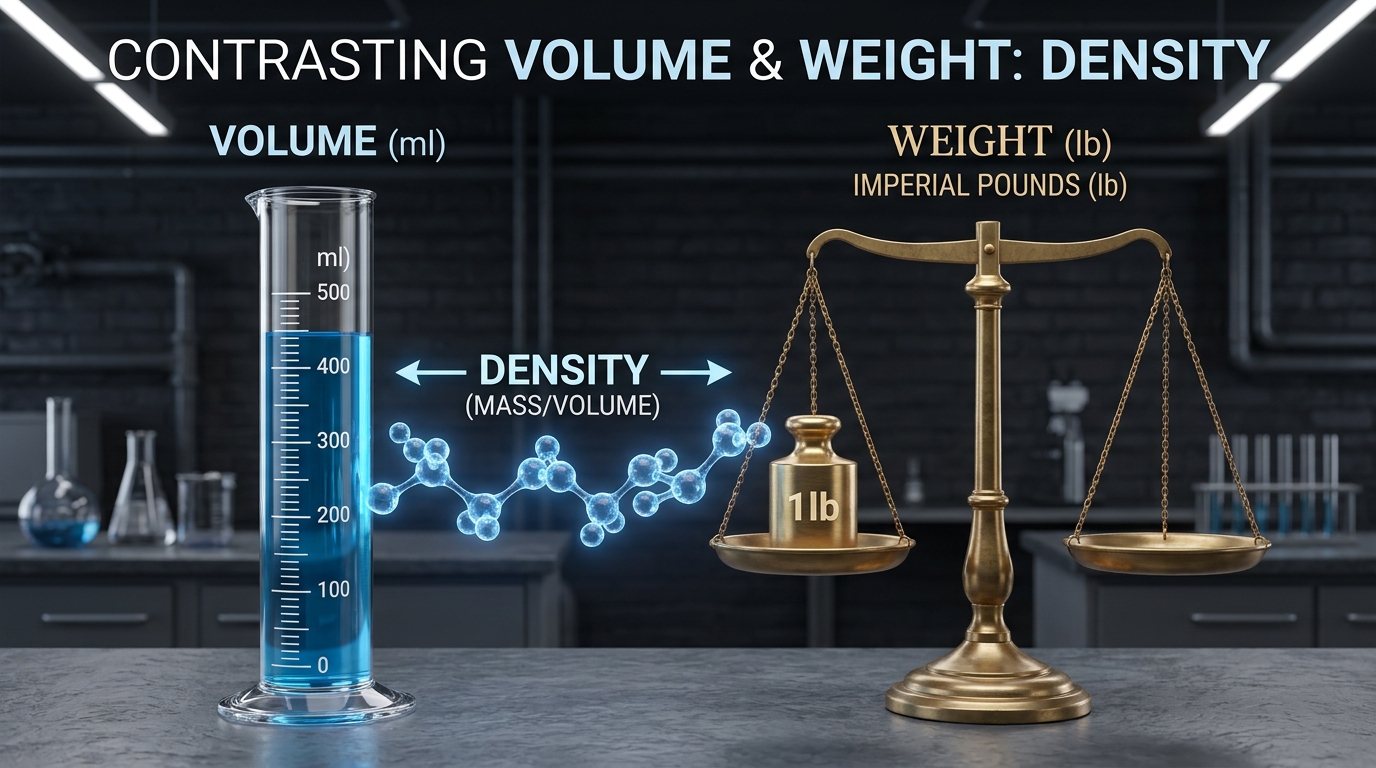
Milliliters (mL) and pounds (lb) are not directly equivalent because they measure different physical quantities: milliliters quantify three-dimensional volumetric space, whereas pounds quantify gravitational mass and weight. For water at standard room temperature, 453.59 mL happens to weigh approximately one pound because water has a density of 1.00 g/mL. For any other substance, weight varies based on molecular packing. To bridge volume and weight, you must incorporate substance density using the formula Pounds = (mL × Density in g/mL) ÷ 453.592, or use our specialized mL to pounds converter and companion mL to grams tool.
What Makes mL and Pounds Different?
Milliliters and pounds cannot be converted without extra data because they exist in separate dimensional categories. When handling a beverage, your eyes perceive volume (how much three-dimensional space it occupies), while your muscles perceive weight (the downward gravitational force acting on its mass). Because everyday experiences center on water, common speech often blurs these concepts together. In physical science, volume and weight share no direct equivalence.
What Does mL Measure?
A milliliter (mL) is a metric unit of volume, defined within the International System of Units (SI) as one cubic centimeter (1 cm³). It is a spatial measurement derived from three spatial dimensions: length × width × height. When a beaker holds 500 mL, it encompasses exactly 500 cubic centimeters of space. That space can hold atmospheric air, light alcohol, or dense liquid metals. Regardless of the substance, the volume remains exactly 500 mL. Milliliters measure geometric capacity independently of gravity or mass.
What Does a Pound Measure?
A pound (lb), specifically the international avoirdupois pound, is a unit of mass and gravitational weight. One avoirdupois pound equals exactly 0.45359237 kilograms (453.592 grams). A pound quantifies how much matter an object contains and the downward gravitational pull on that matter. Unlike milliliters, a pound does not define shape or container dimensions. A 1-pound lead cylinder occupies barely 40 mL of space, while a 1-pound bag of foam beads occupies over 15,000 mL.
Volume vs. Mass: The Key Difference
Dimensional analysis demonstrates why these units cannot be equated directly:
- Volume [Length³]: Expressed in milliliters or cubic centimeters, measuring geometric space.
- Mass [Mass]: Expressed in grams or pounds, quantifying the amount of physical matter.
- Weight [Force]: Mass multiplied by gravitational acceleration (F = m × g), measured on a scale.
Converting milliliters directly to pounds without the substance is like converting hours to miles without speed. Speed bridges time and distance; density bridges volume and mass.
Dimensional Incompatibility: Volume vs. Gravitational Mass
Why Can't You Directly Convert mL to Pounds?
Direct conversions require units of identical dimensionality, such as converting inches to centimeters or kilograms to pounds. Because milliliters and pounds belong to different dimensional families, no universal constant exists that applies to all liquids without knowing substance characteristics.
The Role of Density
Density (ρ) connects volume to mass by measuring the concentration of matter in a unit of space:
Usually expressed in grams per milliliter (g/mL), density reveals how many grams of matter fit into one milliliter. A liquid with a density of 1.20 g/mL yields 1.20 grams per milliliter, while one with 0.80 g/mL yields only 0.80 grams.
How Density Connects Volume and Mass
Density acts as an algebraic converter that cancels out units cleanly:
As density increases, weight in pounds rises proportionally. Without a density figure, the equation cannot be solved.
Why the Substance Being Measured Matters
Every material has a distinct molecular structure. Cooking oils contain loose fatty acid chains that pack loosely. Water molecules form compact hydrogen bonds. Syrups contain dissolved sugars packed into interstitial spaces. Because molecular packing varies, 100 mL of oil, water, and honey contain different numbers of atoms and weigh different amounts.
How the Same Volume Can Have Different Weights
To observe this in practice, consider measuring an identical volume of 1,000 mL (1 liter) across common household liquids. If milliliters and pounds were interchangeable, each liquid would weigh the same. Instead, scale readings differ noticeably.
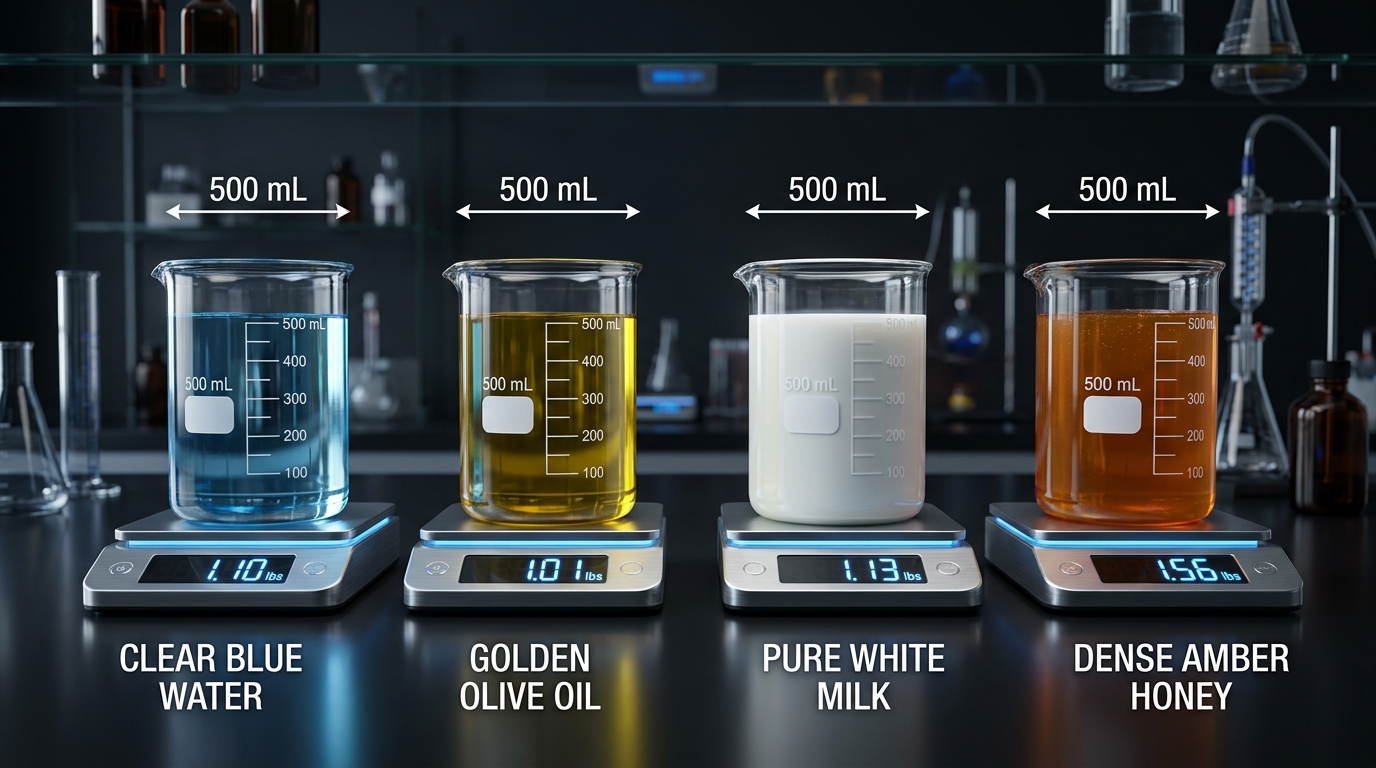
Equal 500 mL volumes produce distinct scale readings: Water (1.10 lb), Olive Oil (1.01 lb), Milk (1.13 lb), and Honey (1.56 lb) due to intrinsic density differences.
Water
Pure distilled water at room temperature (20°C) has a benchmark density of approximately 1.000 g/mL. Weighing 1,000 mL of water produces:
Mass = 1,000 mL × 1.00 g/mL = 1,000 gramsWeight = 1,000 g ÷ 453.592 = 2.205 pounds (lb) Milk
Whole cow's milk contains dissolved sugars, proteins, and butterfat, raising its density to an average of 1.032 g/mL:
Mass = 1,000 mL × 1.032 g/mL = 1,032 gramsWeight = 1,032 g ÷ 453.592 = 2.275 pounds (lb) This 1,000 mL volume weighs 0.07 pounds more than water, accumulating to thousands of pounds across large dairy transports.
Oil
Cooking oils like olive oil are lighter than water despite their viscosity, having an average density of 0.920 g/mL:
Mass = 1,000 mL × 0.920 g/mL = 920 gramsWeight = 920 g ÷ 453.592 = 2.028 pounds (lb) Weighing 0.18 pounds less per liter than water explains why olive oil floats on water in kitchen mixtures.
Honey
Raw honey is a supersaturated sugar solution with low moisture, yielding an average density of 1.420 g/mL:
Mass = 1,000 mL × 1.420 g/mL = 1,420 gramsWeight = 1,420 g ÷ 453.592 = 3.131 pounds (lb) One liter of honey weighs over 1.1 pounds more than one liter of olive oil—a 54% increase in weight for the identical volume.
Other Substances
Comparing multiple liquids demonstrates how widely weight spans across equal volumes:
Table 1: Weight in Pounds for Equal Volumes Across Common Liquids
| Substance | Density (g/mL) | Weight of 500 mL | Weight of 1,000 mL | Variance vs. Water |
|---|---|---|---|---|
| Gasoline (Fuel) | 0.740 g/mL | 0.816 lb | 1.631 lb | -26.0% |
| Rubbing Alcohol (70%) | 0.878 g/mL | 0.968 lb | 1.936 lb | -12.2% |
| Olive Oil | 0.920 g/mL | 1.014 lb | 2.028 lb | -8.0% |
| Water (Baseline) | 1.000 g/mL | 1.102 lb | 2.205 lb | 0.0% |
| Whole Milk | 1.032 g/mL | 1.138 lb | 2.275 lb | +3.2% |
| Pure Glycerin | 1.261 g/mL | 1.390 lb | 2.780 lb | +26.1% |
| Pure Raw Honey | 1.420 g/mL | 1.565 lb | 3.131 lb | +42.0% |
What Happens When Density Changes?
Density is sensitive to chemical composition, dissolved solutes, and temperature. Whenever density shifts, the relationship between volume and weight updates accordingly.
Higher-Density Substances
High-density fluids pack more atomic mass into the same cubic volume. Adding dissolved solutes—such as sugars or salts—fills microscopic spaces between solvent molecules, raising mass with minimal volume expansion. In production facilities, handling dense liquids like syrups or brine often causes surprise because containers feel heavier than expected. A 20-liter container of dense liquid can weigh over 60 pounds, far more than water.
Lower-Density Substances
Lower-density liquids feature lighter molecular structures or wider intermolecular spacing, as seen in fuels and alcohols. Assuming fuel weighs the same as water skews transport estimates. For instance, 1,000 mL of gasoline weighs 1.63 pounds compared to 2.21 pounds of water, an overestimate of nearly 26% if water's density is assumed.
Equal Volumes With Different Weights
Equal volumes regularly display unequal weights:
- 500 mL of rubbing alcohol (0.786 g/mL) weighs 0.866 pounds.
- 500 mL of vegetable glycerin (1.261 g/mL) weighs 1.390 pounds.
Both occupy identical shelf space, yet the glycerin weighs 60% more. Overlooking this variation leads to significant packaging and formulation errors.
Is 1 mL Equal to 1 Gram?
A frequent source of conversion errors is the familiar shortcut: "1 mL equals 1 gram." This relationship is not a universal constant; it was engineered specifically for pure water under controlled lab conditions.
When 1 mL Is Approximately 1 Gram
1 mL equals 1 gram only for pure water at 4°C (39.2°F), where water attains its maximum density of 1.0000 g/mL. At room temperature (20°C), water expands slightly to 0.9982 g/mL. While this 0.18% difference is negligible in cooking, it shows that even water varies across temperatures.
Why This Does Not Apply to Every Substance
For other liquids, the 1:1 rule fails entirely. One milliliter of ethanol weighs 0.789 grams, while one milliliter of chloroform weighs 1.489 grams. Assuming 1 mL = 1 gram for these substances introduces immediate conversion errors into subsequent calculations.
Why Water Is Commonly Used as a Reference
When the French Academy created the metric system in 1795, scientists defined the gram as the mass of one cubic centimeter of water at freezing. Water provided an accessible, reproducible standard across laboratories, serving as a universal baseline for specific gravity comparisons.
Can mL Be Converted to Pounds Without Density?
The short answer from physics is: No. Milliliters cannot be converted to pounds without density because doing so requires equating two physically incompatible dimensions without a conversion rate.
When Density Is Required
Density is mandatory whenever precision, safety, or legal compliance matters:
- Food Production: Scaling recipes from test kitchens to commercial batches requires exact densities to preserve texture and moisture balance.
- Freight Logistics: Carriers bill by scale weight. Calculating cargo weight with water's density creates billing disputes and safety compliance issues.
- Chemical Formulations: Active pharmaceutical ingredients demand strict gravimetric accuracy to ensure proper dosing.
When an Approximation May Be Used
Approximations are acceptable only when two conditions are met:
- The liquid is predominantly water (such as black coffee, tea, light broth, or dilute vinegar).
- The stakes are low, such as informal home recipe preparation.
Because brewed coffee is over 98% water, assuming a density of 1.00 g/mL introduces less than a 0.2% error, which is negligible at home.
Why Using Water's Density Can Give the Wrong Result
Applying water's density to non-aqueous liquids causes major errors. For example, packaging 2,000 bottles of almond oil (0.915 g/mL) at 250 mL each equals 500,000 mL. If water's density is used:
Water Assumption: 500,000 mL ÷ 453.592 = 1,102.3 lbActual Liquid Weight: (500,000 × 0.915) ÷ 453.592 = 1,008.6 lb The estimate is off by nearly 94 pounds, inflating freight expenses and misrepresenting net contents on consumer packaging.
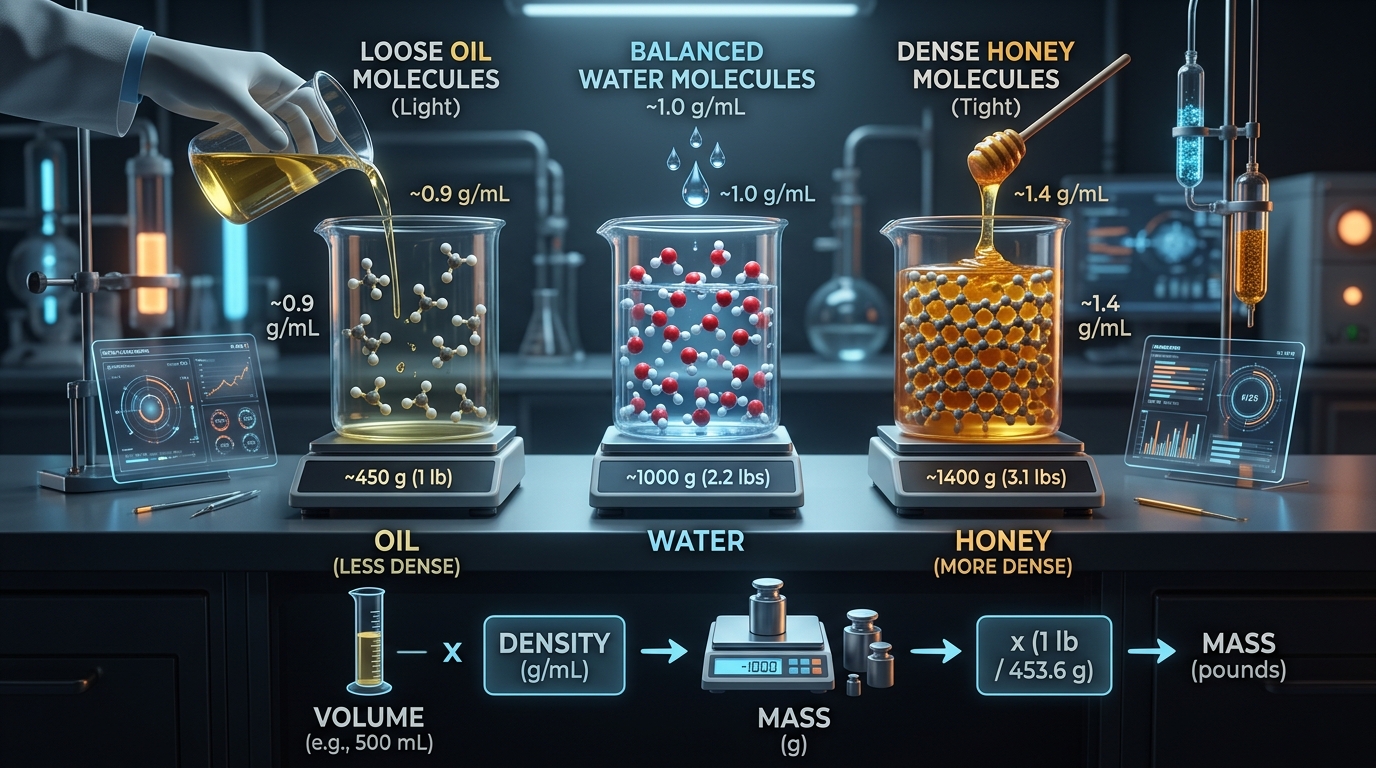
Molecular density governs unit conversion: loose oil molecules yield fewer pounds per mL, while tightly packed honey yields substantially more pounds per mL.
How Density Affects mL to Pounds Calculations
Examining the conversion equation reveals how density functions as a direct multiplier:
The bracketed term functions as a substance-specific conversion factor.
Higher Density Means More Weight
Substances with densities above 1.00 g/mL yield more pounds than an equal volume of water:
- 500 mL of water =
500 × 1.00 ÷ 453.592 = 1.102 lb - 500 mL of glycerin (1.261 g/mL) =
500 × 1.261 ÷ 453.592 = 1.390 lb
Because glycerin is 26.1% denser than water, 500 mL of glycerin weighs 26.1% more in pounds. You can verify these numbers with our density calculator and density to mass calculator.
Lower Density Means Less Weight
Substances with densities below 1.00 g/mL yield fewer pounds per milliliter:
- 500 mL of water =
500 × 1.00 ÷ 453.592 = 1.102 lb - 500 mL of mineral spirits (0.780 g/mL) =
500 × 0.780 ÷ 453.592 = 0.860 lb
Mineral spirits weigh 22% less than water, lightening payload requirements in shipping.
Comparing Equal Volumes of Different Substances
To see this across a common commercial volume, observe how 750 mL (a standard bottle size) translates to pounds:
Weight Comparison of 750 mL Across Different Liquids
A 750 mL bottle of honey weighs over one pound more than the same bottle filled with acetone. Across a wholesale shipment of 1,000 bottles, this density variance equals an extra 1,040 pounds of freight.
Common Misunderstandings About mL and Pounds
Confusion between volume and weight causes repeated errors in commercial kitchens, labs, and shipping facilities. The four most common misunderstandings include:
Assuming mL Is a Weight Unit
Consumers often think milliliters measure weight because product labels show mL alongside ounces or grams. Milliliters measure capacity, never weight. A 100 mL container of air registers near zero on a scale, while 100 mL of honey registers nearly 1.5 pounds.
Assuming 1 mL Always Has the Same Weight
Because introductory science teaches that 1 mL of water equals 1 gram, many people assume every liquid shares this 1:1 ratio. Cooks who pour 250 mL of oil onto a scale expecting 250 g often suspect scale failure when it reads 230 g.
Confusing Mass, Weight, and Volume
Volume measures spatial displacement. Mass measures the quantity of matter. Weight measures gravitational pull on that mass. A 500 mL bottle of water taken to the Moon keeps its 500 mL volume and 500 g mass, but its weight falls from 1.10 lb to 0.18 lb. Learn more in our guide on volume to mass conversion.
Assuming Water's Conversion Applies to Everything
Generic online converters often apply water's density automatically without requesting liquid type. Converting 1,000 mL returns 2.205 pounds regardless of input, producing inaccurate numbers for honey, syrup, or oil.
Need Fast, Density-Accurate Calculations?
Eliminate conversion errors with our pre-calibrated tools designed for kitchen recipes, laboratory research, and freight shipping.
Frequently Asked Questions About mL and Pounds
Why are mL and pounds not directly equivalent?
Milliliters (mL) and pounds (lb) are not directly equivalent because they measure completely different physical properties. Milliliters measure geometric volume (spatial capacity), whereas pounds measure gravitational mass and weight. Converting between volume and weight requires knowing substance density, which defines how much mass fits into each unit of volume. Without knowing the substance, a direct conversion is impossible.
Does 1 mL always weigh 1 gram?
No, 1 mL does not always weigh 1 gram. This 1:1 ratio applies only to pure water at approximately 4°C (39.2°F), where water has a density of exactly 1.00 g/mL. For all other substances, 1 mL weighs more or less than 1 gram depending on molecular density. For example, 1 mL of olive oil weighs approximately 0.92 grams, while 1 mL of honey weighs about 1.42 grams.
Why does density matter when converting mL to pounds?
Density matters because it provides the mathematical bridge between volume and mass. Density expresses how many grams of matter occupy one milliliter of space. Multiplying volume by density determines the total mass in grams, which is then divided by 453.592 to calculate pounds. Without density, there is no mathematical link between cubic space and weight.
Can you convert mL to pounds without knowing the substance?
No, you cannot accurately convert mL to pounds without knowing the substance. Because liquids vary in density from 0.74 g/mL for gasoline to 1.42 g/mL for honey, 500 mL can weigh anywhere from 0.81 pounds to over 1.56 pounds. Any conversion performed without identifying the substance is merely an assumption based on water.
Does a higher density mean more pounds for the same mL?
Yes, higher density directly increases weight in pounds. In the formula Pounds = (mL × Density) ÷ 453.592, density is directly proportional to final weight. Because raw honey (1.42 g/mL) is denser than olive oil (0.92 g/mL), 1,000 mL of honey weighs 3.13 pounds compared to just 2.03 pounds for olive oil.
Are mL and pounds measuring the same thing?
No, they measure fundamentally different physical phenomena. Milliliters measure geometric displacement (volume), while pounds measure the gravitational force acting on physical matter (weight). They belong to distinct physical dimensions and cannot be equated without knowing material density.
Conclusion
The assumption that milliliters and pounds can be directly swapped is an understandable byproduct of our daily familiarity with water. Because one liter of water weighs approximately one kilogram and 2.2 pounds, people commonly assume that volume and weight are equivalent across all liquids.
Volume and weight represent separate dimensions. Milliliters quantify geometric space, while pounds quantify gravitational mass. Because matter packs together at different molecular densities—from light vegetable oils that float on water to heavy syrups that sink—the weight of any volume depends entirely on the substance measured.
Whenever you need to convert between these units, always identify your substance, confirm its density in g/mL, and apply the formula Pounds = (mL × Density) ÷ 453.592. By keeping volume and mass distinct, you ensure accuracy across culinary recipes, commercial shipping manifests, and laboratory formulations.