Executive Overview
For pure water at room temperature, volume and mass match directly: 1 mL equals 0.001 kg, 500 mL equals 0.5 kg, and 1,000 mL equals 1 kg. For other liquids, density changes the outcome: 1,000 mL of olive oil weighs 0.918 kg, while 1,000 mL of honey weighs 1.420 kg. This guide provides conversion tables from 1 mL to 5,000 mL, liquid comparisons, formulas, and practical tips. For instant calculations, try our interactive mL to kg converter.
Live Common mL to kg Visualizer
Select any common milliliter measurement and liquid substance to inspect the exact mass in kilograms, grams, and pounds.
Common mL to kg Conversions
Volumetric measurements appear in recurring standard increments across culinary, healthcare, and chemical settings. Milliliters indicate spatial volume, while kilograms measure matter mass. Converting between them requires multiplying volume by density and dividing by 1,000. For water, this follows a decimal progression. To review fundamental density principles, see why density matters in mL to kg conversions.
1 mL to kg
For pure water at 4°C, 1 mL equals 0.001 kg (1 gram). For olive oil, 1 mL equals 0.00092 kg, while for honey it equals 0.00142 kg.
10 mL to kg
A volume of 10 mL of water equals 0.01 kg (10 grams). For whole milk, 10 mL weighs 0.01032 kg; for cooking oil, 0.0092 kg.
50 mL to kg
A volume of 50 mL of water equals 0.05 kg (50 grams). For essential oil, 50 mL weighs 0.044 kg, while glycerin weighs 0.063 kg.
100 mL to kg
A volume of 100 mL of water equals 0.1 kg (100 grams). Whole milk at 100 mL weighs 0.1032 kg, while olive oil weighs 0.0918 kg.
250 mL to kg
A volume of 250 mL of water equals 0.25 kg (250 grams). For whole milk, 250 mL weighs 0.258 kg; for honey, 0.355 kg.
500 mL to kg
A volume of 500 mL of water equals 0.5 kg (500 grams, or half a kilogram). Filled with vegetable oil, 500 mL weighs 0.460 kg.
750 mL to kg
A volume of 750 mL of water equals 0.75 kg (750 grams). Due to alcohol content, a 750 mL wine bottle contains about 0.745 kg.
1,000 mL to kg
A volume of 1,000 mL of water equals 1 kg (1,000 grams). Olive oil weighs 0.918 kg, whole milk weighs 1.032 kg, and honey weighs 1.420 kg.
1,500 mL to kg
A volume of 1,500 mL of water equals 1.5 kg (1,500 grams). Preparing 1,500 mL of culinary stock yields approximately 1.53 kg.
2,000 mL to kg
A volume of 2,000 mL of water equals 2 kg (2,000 grams). Filled with fresh water, it adds two kilograms; with motor oil, it weighs 1.74 kg.
5,000 mL to kg
A volume of 5,000 mL of water equals 5 kg (5,000 grams). Filled with industrial syrup or liquid fertilizer, it can exceed 6.8 kg.
The Volume-to-Mass Metric Ladder (Water at 4°C)
Master Quick Reference: Common mL Volumes to kg for Pure Water
| Volume (mL) | Grams (g) | Kilograms (kg) | Pounds (lb) | Container Type |
|---|---|---|---|---|
| 1 mL | 1 g | 0.001 kg | 0.0022 lb | Eye dropper (~20 drops) |
| 10 mL | 10 g | 0.010 kg | 0.0220 lb | Oral medicine cup |
| 50 mL | 50 g | 0.050 kg | 0.1102 lb | Culinary shot glass |
| 100 mL | 100 g | 0.100 kg | 0.2205 lb | Travel bottle / Airport limit |
| 250 mL | 250 g | 0.250 kg | 0.5512 lb | Metric measuring cup |
| 500 mL | 500 g | 0.500 kg | 1.1023 lb | Personal water bottle |
| 750 mL | 750 g | 0.750 kg | 1.6535 lb | Standard wine bottle |
| 1,000 mL | 1,000 g | 1.000 kg | 2.2046 lb | One-liter pitcher / carton |
| 1,500 mL | 1,500 g | 1.500 kg | 3.3069 lb | Magnum beverage bottle |
| 2,000 mL | 2,000 g | 2.000 kg | 4.4092 lb | Two-liter bottle |
| 5,000 mL | 5,000 g | 5.000 kg | 11.0231 lb | Five-liter canister |
mL to kg Conversion Chart for Water
Water provides the anchor for metric mass: one milliliter of pure water equals one cubic centimeter and weighs one gram at 4°C. Dividing measurements into three tiers clarifies domestic, lab, and industrial calculations.
Small Volume Measurements
Small volumes range from 1 mL to 100 mL, typical of oral syringes, pipettes, and food extracts. A water drop is roughly 0.05 mL (0.00005 kg). One teaspoon holds 5 mL (0.005 kg), one tablespoon holds 15 mL (0.015 kg), and 100 mL provides 0.100 kg.
Medium Volume Measurements
Medium volumes cover 125 mL to 800 mL, representing mugs, cans, and recipe measures. A 330 mL can holds 0.330 kg of water. In bread baking, 350 mL provides 0.350 kg for exact hydration. At 500 mL, water weighs 0.500 kg, and at 750 mL, it weighs 0.750 kg.
Large Volume Measurements
Large volumes cover 1,000 mL to 10,000 mL (1 to 10 liters). In catering and freight, liquid mass dictates lifting limits. At 1,000 mL, water weighs 1.000 kg. At 2,500 mL, the mass is 2.500 kg. A ten-liter bucket holding 10,000 mL weighs 10.000 kg.
Water Volume Categories: Small, Medium, and Large Tiers
mL to kg Conversions for Common Liquids
Beyond water, liquids possess unique densities governing weight. Converting milliliters to kilograms requires multiplying volume by density and dividing by 1,000. To examine broader chemical values, consult our liquid density database.
Water
Pure water sets the baseline density of 1.000 g/mL. Thus, 250 mL equals 0.250 kg, and 1,000 mL equals 1.000 kg:
Water Mass (kg) = Volume (mL) ÷ 1,000 Milk
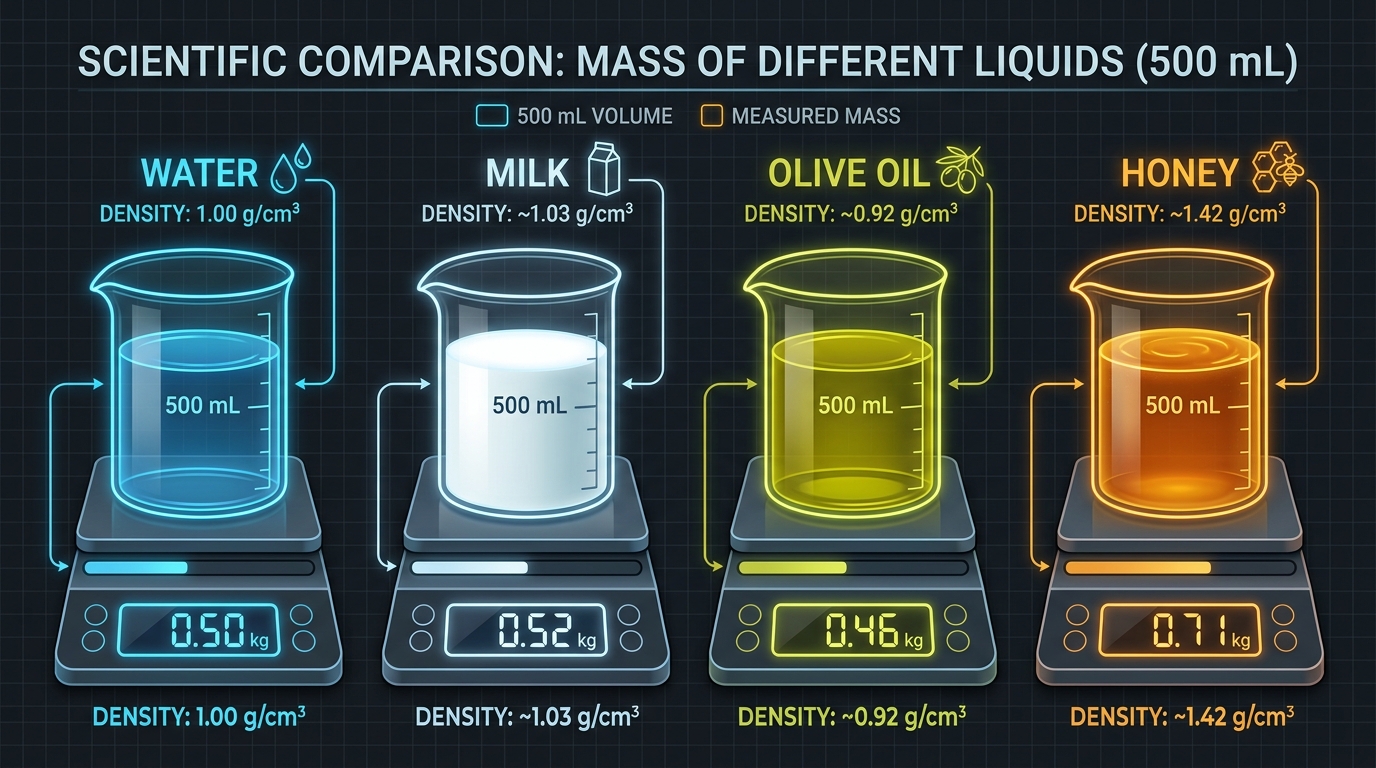
Whole milk averages 1.032 g/mL due to lactose, proteins, and minerals. 500 mL weighs 0.516 kg, and 1,000 mL weighs 1.032 kg:
Milk Mass (kg) = Volume (mL) × 1.032 ÷ 1,000 Olive Oil
Extra virgin olive oil has an average density of 0.918 g/mL. 500 mL weighs 0.459 kg, while 1,000 mL weighs 0.918 kg:
Olive Oil Mass (kg) = Volume (mL) × 0.918 ÷ 1,000 Vegetable Oil
Standard cooking oil (canola, soybean) averages 0.920 g/mL. 1,000 mL weighs 0.920 kg, while 5,000 mL weighs 4.600 kg:
Vegetable Oil Mass (kg) = Volume (mL) × 0.920 ÷ 1,000 Honey
Natural honey averages a dense 1.420 g/mL. 100 mL weighs 0.142 kg, 500 mL weighs 0.710 kg, and 1,000 mL weighs 1.420 kg:
Honey Mass (kg) = Volume (mL) × 1.420 ÷ 1,000 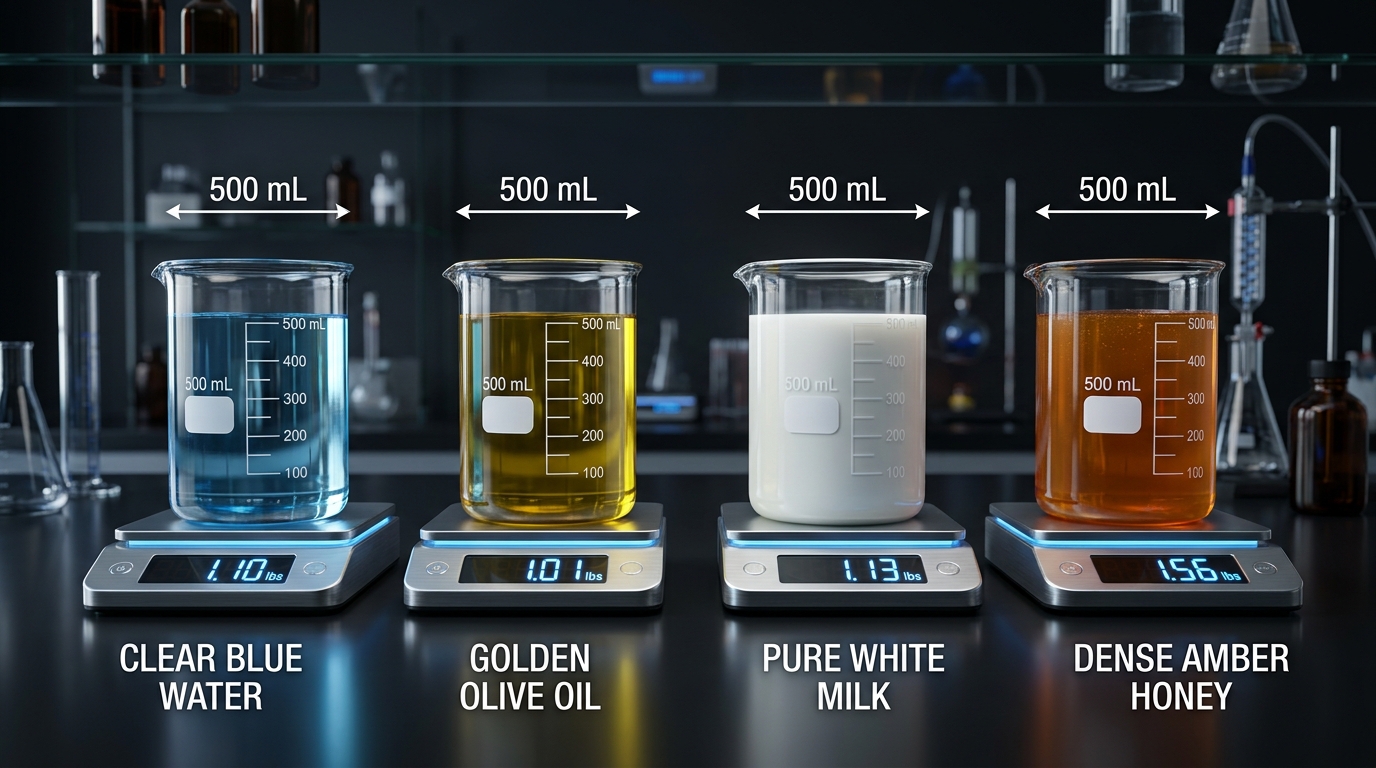 Figure 1: Equal 500 mL volumes of honey, water, and olive oil produce vastly different mass readings due to liquid density.
Mass of 1,000 mL Across Common Everyday Liquids
Comparing the Same mL Volume Across Different Liquids
Fixing volume constant while comparing masses reveals the direct impact of density. For custom calculations, use our density calculator and volume-to-mass converter.
100 mL of Different Liquids
At 100 mL, representing a small cup or travel bottle, clear mass differences appear:
- Pure Water: 100 mL = 0.1000 kg
- Whole Milk: 100 mL = 0.1032 kg
- Olive Oil: 100 mL = 0.0918 kg
- Vegetable Oil: 100 mL = 0.0920 kg
- Clover Honey: 100 mL = 0.1420 kg
Honey is 54 percent heavier than olive oil for the exact same 100 mL space.
500 mL of Different Liquids
A 500 mL volume represents a standard beverage container:
- Pure Water: 500 mL = 0.5000 kg
- Whole Milk: 500 mL = 0.5160 kg
- Olive Oil: 500 mL = 0.4590 kg
- Vegetable Oil: 500 mL = 0.4600 kg
- Clover Honey: 500 mL = 0.7100 kg
Packaging check-weighers calibrated for water reject 500 mL oil bottles as underweight (0.459 kg) and honey jars as overweight (0.710 kg).
1,000 mL of Different Liquids
At one liter (1,000 mL), volumetric differences translate into substantial mass consequences:
- Pure Water: 1,000 mL = 1.0000 kg
- Whole Milk: 1,000 mL = 1.0320 kg
- Olive Oil: 1,000 mL = 0.9180 kg
- Vegetable Oil: 1,000 mL = 0.9200 kg
- Clover Honey: 1,000 mL = 1.4200 kg
Shipping 1,000 liters of olive oil adds 918 kg of freight weight, whereas 1,000 liters of honey adds 1,420 kg—a 502 kg payload difference.
Why mL to kg Values Differ Between Liquids
The mass disparity between equal liquid volumes stems from molecular composition. Milliliters measure spatial volume, while kilograms measure matter mass. Density serves as the physical bridge connecting these units.
Density and Mass
Density is mathematically expressed as ρ = m ÷ V. Isolating mass produces m = V × ρ. When volume is in mL and density is in g/mL, dividing by 1,000 yields kilograms:
Mass in kg = [Volume in mL × Density (g/mL)] ÷ 1,000 Density acts as a direct scaling multiplier. If fluid A has twice the density of fluid B, then 500 mL of fluid A contains twice the mass of 500 mL of fluid B.
Liquids Less Dense Than Water
Fluids with densities below 1.000 g/mL produce fewer kilograms than volume divided by 1,000. Examples include oils (0.91 to 0.93 g/mL), ethanol (0.789 g/mL), and gasoline (0.74 g/mL). Loose molecular packing allows them to float on water.
Liquids More Dense Than Water
Fluids with densities above 1.000 g/mL yield higher kilogram values than volume divided by 1,000. Examples include whole milk (1.032 g/mL), maple syrup (1.37 g/mL), and honey (1.42 g/mL). These contain heavy dissolved solutes tightly packed together.
How to Find a Specific mL to kg Conversion
Determining an accurate mL to kg conversion for any fluid requires a reliable four-step protocol that eliminates decimal errors and guarantees repeatable results.
Identify the Volume
Establish the exact liquid volume in milliliters (mL). If recorded in liters, multiply by 1,000 (2.5 L = 2,500 mL). For transparent fluids in graduated glassware, take the reading at the bottom curvature of the meniscus at eye level.
Identify the Substance
Verify the exact identity, grade, and temperature of the liquid. Generic labels like "oil" introduce uncertainty because olive oil (0.918 g/mL) differs from motor oil (0.870 g/mL), and light syrup differs from heavy syrup.
Find the Appropriate Density
Locate the verified density value in g/mL or kg/L. Refer to verified physical reference tables, material safety data sheets, or measure the sample directly with a calibrated laboratory hydrometer.
Determine the Mass in kg
Execute the formula: multiply milliliters by density in g/mL, then divide by 1,000. For 750 mL of olive oil: (750 × 0.918) ÷ 1,000 = 0.6885 kg.
The 4-Step mL to kg Conversion Flowchart
Are mL to kg Conversion Values Always the Same?
No, conversion values are not static constants. They fluctuate based on three environmental and physical variables: intrinsic density variations, operating temperatures, and chemical formulations.
Effect of Density
Liquids vary in density due to molecular packing and seasonal harvest variations. Raw dairy milk shifts between 1.028 and 1.035 g/mL depending on butterfat levels. Early-crop olive oil is slightly denser than late-season oil. Relying on static assumptions introduces systematic deviations into quality testing.
Effect of Temperature
Through thermal expansion, heating a fluid causes molecules to move vigorously and spread apart, reducing its density. While 1,000 mL of pure water at 4°C weighs 1.0000 kg, at 25°C it weighs 0.9970 kg, and at 95°C it weighs only 0.9619 kg (a 38-gram difference). Commercial custody transfers normalize volumes to 15°C or 20°C.
Effect of Substance Composition
Dissolved solutes significantly increase liquid mass. Adding 35 grams of mineral salts per liter transforms fresh water into seawater with a density of 1.025 g/mL. Dissolving sugar elevates simple syrup density up to 1.33 g/mL. Monitoring dissolved solids with a digital refractometer ensures formulation accuracy.
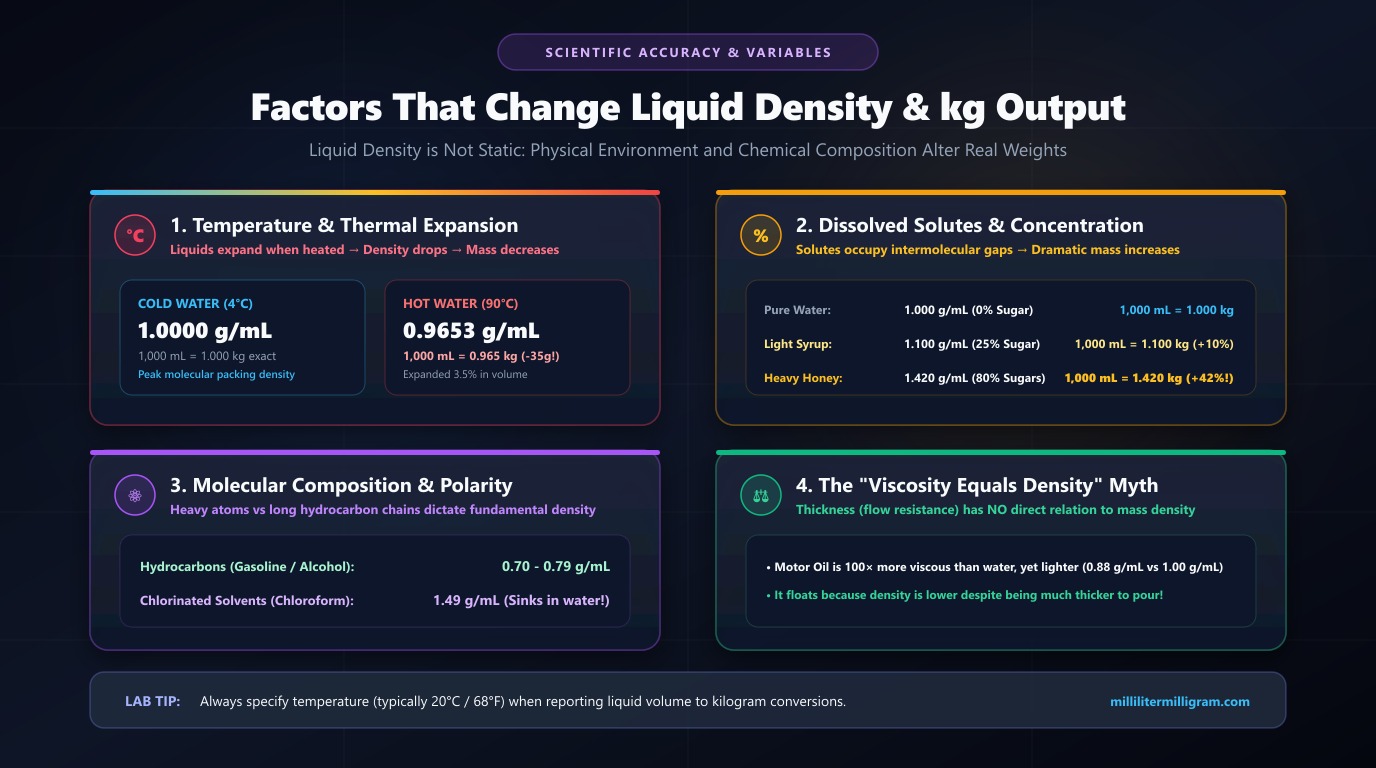 Figure 2: Thermal expansion and dissolved solute concentration alter the mass contained inside any fixed milliliter volume.
Thermal Expansion: Mass of 1,000 mL of Water Across Temperatures
Common Mistakes When Using mL to kg Charts
Conversion tables serve as practical guides, but using them indiscriminately causes recurring errors. We frequently observe four primary miscalculations across commercial kitchens and laboratories.
Assuming 1,000 mL Always Equals 1 kg
Treating milliliters and grams as interchangeable across all liquids is the most widespread mistake. This equivalence holds strictly for water. For cooking oils, it introduces an eight percent shortage, while for honey, it causes a 42 percent underestimation of weight.
Using Water Values for Other Liquids
Using water data to dispense chemical additives, detergents, or active syrups alters formulation ratios. In agricultural spraying or pharmaceutical dispensing, this oversight compromises effectiveness. Always incorporate substance-specific density factors.
Confusing mL With kg
Because both units belong to the metric system, operators occasionally confuse volume milliliters with mass kilograms on production sheets, creating thousandfold errors. Milliliters measure volume, whereas kilograms measure mass. For metric unit transitions, consult our mL to grams tool.
Using Rounded Values as Exact Measurements
Rounding olive oil density to 0.9 g/mL rather than 0.918 g/mL introduces a two percent variance. In a 20,000-liter tanker shipment, that simplification miscalculates cargo weight by 360 kilograms. Always preserve three significant decimal places for industrial calculations.
Frequently Asked Questions About mL to kg Measurements
How Many kg Is 100 mL?
For water, 100 mL equals 0.1 kg (100 g). For milk, it weighs 0.1032 kg; olive oil, 0.0918 kg; honey, 0.1420 kg.
How Many kg Is 250 mL?
For water, 250 mL equals 0.25 kg (250 g). Whole milk weighs 0.2580 kg, olive oil weighs 0.2295 kg, and honey weighs 0.3550 kg.
How Many kg Is 500 mL?
For water, 500 mL equals 0.5 kg (500 g). Cooking oil weighs 0.4600 kg, milk weighs 0.5160 kg, and honey weighs 0.7100 kg.
How Many kg Is 750 mL?
For water, 750 mL equals 0.75 kg (750 g). Dry wine weighs approximately 0.745 kg, and olive oil weighs 0.6885 kg.
How Many kg Is 1,000 mL?
For water at 4°C, 1,000 mL equals exactly 1.000 kg (1,000 g). Milk weighs 1.032 kg, vegetable oil weighs 0.920 kg, and honey weighs 1.420 kg.
How Many kg Is 2,000 mL?
For water, 2,000 mL equals 2.000 kg (2,000 g). Motor oil weighs 1.740 kg, while clover honey weighs 2.840 kg.
Is 1,000 mL Always Equal to 1 kg?
No. 1,000 mL equals 1 kg only for pure water at 4°C. Oils and alcohols weigh less than 1 kg, while syrups weigh more.
How Many mL Are in 1 kg?
For water, 1,000 mL equals 1 kg. For olive oil, 1 kg occupies 1,089.3 mL. For honey, 1 kg occupies 704.2 mL. For reverse conversions, see our mL to liters tool and conversion guide.
Key Takeaways for mL to kg Measurements
The Water Baseline Rule
For pure water, volume and mass align directly: 1 mL equals 0.001 kg, 100 mL equals 0.1 kg, 500 mL equals 0.5 kg, and 1,000 mL equals 1.0 kg.
The Universal Formula
Calculate mass using kg = (mL × density in g/mL) ÷ 1,000. Always multiply volume by density before dividing into kilograms.
Everyday Container Benchmarks
Key reference points: a teaspoon holds 5 mL (0.005 kg water), a metric cup holds 250 mL (0.25 kg water), and a bottle holds 500 mL (0.5 kg water).
Gravimetric Precision
Culinary professionals and laboratory technicians weigh liquids on digital scales rather than relying on graduated beakers to avoid meniscus reading errors.
Key Takeaways About Density and mL to kg Conversion
Density Is the Essential Bridge
Milliliters quantify 3D volume while kilograms quantify matter mass. Density is the physical coefficient that links volume to mass.
Temperature Changes Density
Liquids expand when heated and contract when chilled. One liter of boiling water weighs nearly 38 grams less than chilled water.
Substantial Liquid Variance
Common kitchen liquids vary widely: cooking oil yields ~0.92 kg per liter, while honey yields ~1.42 kg. Honey is 54 percent denser than oil.
Dissolved Solutes Shift Mass
Dissolved sugars, salts, and minerals raise liquid density. Always test custom brines and syrups with a hydrometer before converting.
Need an Instant mL to kg Conversion?
Use our dedicated metric conversion calculator with preloaded density constants for over 80 common liquids and chemicals.
Open mL to kg Calculator →