Executive Summary
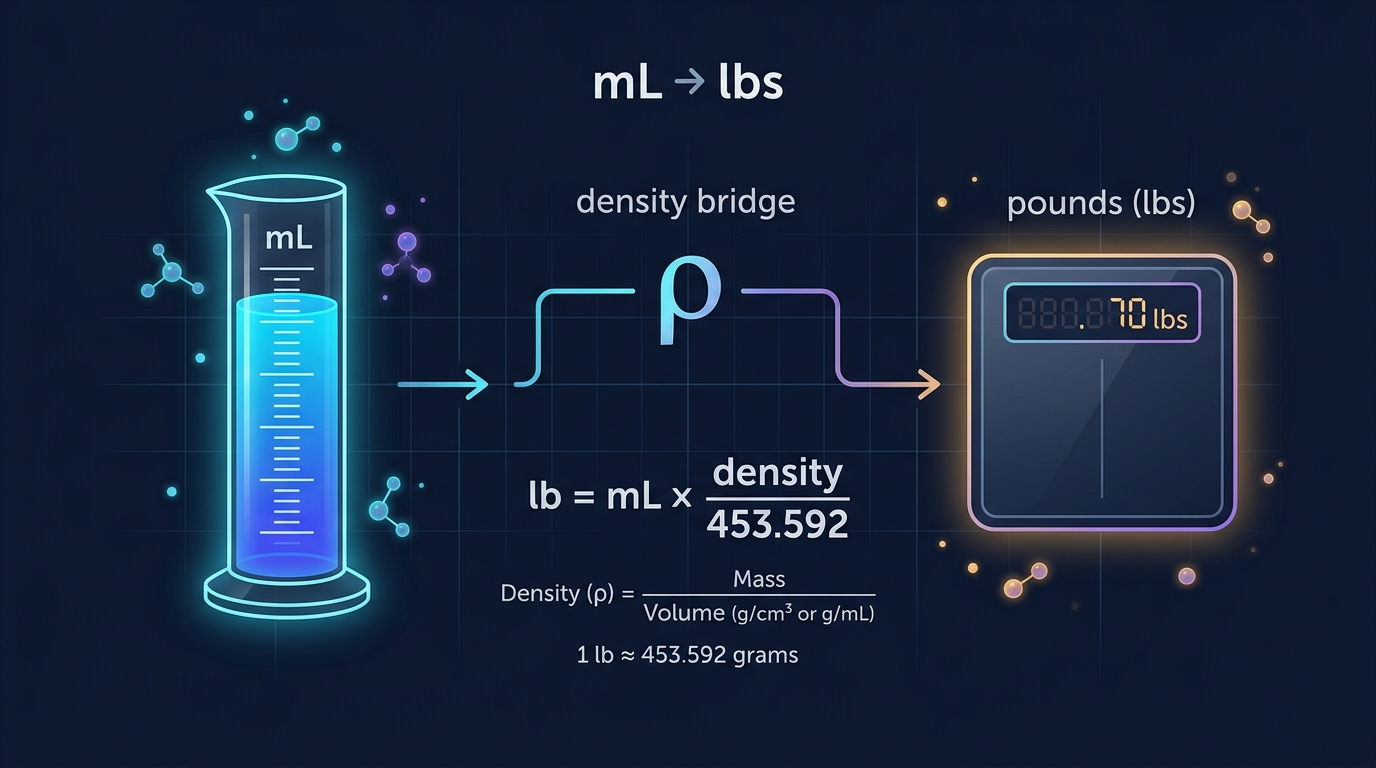
Converting milliliters to pounds is not a direct one-step calculation. Milliliters quantify volume while pounds quantify weight, and the only way to bridge these two fundamentally different measurements is through density. In this guide, you will learn the exact formula (lb = mL x density / 453.592), walk through real calculations for water, milk, oil, and honey, explore our mL to pounds calculator, and discover the most common mistakes that cause inaccurate results. Whether you are working in a kitchen scaling recipes or in a lab preparing formulations, this deep-dive will give you the precision and confidence to convert any liquid volume into its correct weight in pounds.
Why Density Is Needed to Convert mL to Pounds
This question trips up more people than you would expect. I once watched a home brewer confidently pour 500 mL of maple syrup onto a kitchen scale and announce it weighed "about one pound." The scale actually read 1.47 pounds. His assumption that volume equals weight cost him an entire batch of autumn ale. Here is why density is the non-negotiable middle step in every mL-to-pound conversion.
mL Measures Volume While Pounds Measure Mass
Milliliters belong to the metric system and strictly describe how much three-dimensional space a substance occupies. One milliliter equals one cubic centimeter. Pounds, on the other hand, belong to the imperial system and measure gravitational weight. They tell you how heavy something is, not how much room it takes up. These two units live in completely separate measurement categories. Trying to convert between them without a bridge factor is like converting hours into kilometers. The numbers do not overlap naturally.
Think about it practically: 500 mL of feathers piled loosely in a graduated cylinder would weigh almost nothing. But 500 mL of mercury would weigh over 14 pounds. The volume is identical. The weight is wildly different. That difference comes down to one property: density.
How Density Connects Volume and Weight
Density is the physical property that tells you how much mass fits inside a specific volume. Scientists express density as grams per milliliter (g/mL) or kilograms per liter (kg/L). When you know a substance's density, you can multiply it by the volume to get the mass in grams, and then convert those grams into pounds. Density acts as the mathematical translator between the metric volume world and the imperial weight world.
How Density Bridges Volume to Weight
Can You Convert mL to Pounds Without Density?
The short answer is no. Without knowing the density of the substance you are measuring, any mL to pound calculation is a guess at best. Some online converters will assume you are measuring water (density = 1.0 g/mL) and spit out a result, but that answer is only accurate for pure water at room temperature. For every other liquid, powder, or mixture, skipping density introduces errors ranging from 5% to over 1,000% depending on the substance. Our mL to pounds converter includes built-in density values for dozens of common substances specifically to solve this problem.
What Is the Formula for Converting mL to Pounds?
Once you understand why density is essential, the actual math becomes surprisingly straightforward. I remember the first time I taught this formula to a group of culinary students. They expected something complicated. When I wrote it on the board, half the class visibly relaxed. The formula has only three components.
mL to Pounds Formula
This two-step formula first converts milliliters into grams using density, and then converts grams into pounds using the fixed conversion factor of 453.592 grams per pound. The number 453.592 is not arbitrary. It is the internationally agreed conversion between the metric gram and the imperial pound (avoirdupois).
Converting Density to the Correct Units
Before applying the formula, make sure your density is in grams per milliliter (g/mL). If you find a density listed in kg/m3, divide by 1,000. If the density is in lb/ft3, multiply by 0.016018. If your source lists specific gravity (SG), you are in luck because specific gravity for liquids at standard conditions is numerically identical to density in g/mL. A substance with a specific gravity of 1.03 has a density of 1.03 g/mL.
Density Unit Conversion Reference
| Source Unit | Conversion to g/mL | Example |
|---|---|---|
| kg/m3 | Divide by 1,000 | 1,030 kg/m3 = 1.03 g/mL |
| lb/ft3 | Multiply by 0.016018 | 62.4 lb/ft3 = 1.00 g/mL |
| Specific Gravity | Same numerical value | SG 0.92 = 0.92 g/mL |
| g/cm3 | Same numerical value | 1.42 g/cm3 = 1.42 g/mL |
Understanding Each Part of the Formula
The formula contains three distinct elements working together. Volume in mL represents how much liquid you are converting. Density in g/mL translates that volume into mass. The constant 453.592 converts the resulting gram value into pounds. Missing or incorrectly applying any single element makes the entire calculation wrong. I learned this the hard way during a college chemistry lab when I accidentally used density in kg/L instead of g/mL, turning a 0.5-pound measurement into a 500-pound absurdity that my professor still jokes about.
How to Calculate mL to Pounds Step by Step
Theory is great, but let me walk you through the actual process. This is the method I use every single time, and it has never failed me in over a decade of measurement work. Follow these four steps and you will get an accurate result every time.
Four-Step Conversion Process
Step 1: Determine the Volume in mL
Start with the exact volume you need to convert. Use a graduated cylinder, measuring cup, or volumetric flask for best accuracy. If your volume is listed in liters, multiply by 1,000 to get milliliters. If it is in fluid ounces, multiply by 29.5735 to convert to mL. Precision at this stage directly affects your final result in pounds.
Step 2: Find the Substance's Density
Look up the density of your specific substance. You can find density values on product data sheets, in chemistry reference tables, or through our density calculator tool. Common densities include water at 1.00 g/mL, whole milk at 1.03 g/mL, olive oil at 0.92 g/mL, and honey at 1.42 g/mL. Temperature affects density, so try to use values measured at the temperature closest to your actual conditions.
Step 3: Calculate the Mass
Multiply your volume in mL by the density in g/mL. The result gives you the mass in grams. For example, 750 mL of olive oil at 0.92 g/mL gives you 750 x 0.92 = 690 grams. This intermediate step is critical and should not be skipped or mentally estimated.
Step 4: Convert the Mass to Pounds
Divide the mass in grams by 453.592 to get the weight in pounds. Continuing the olive oil example: 690 / 453.592 = 1.52 pounds. That is your final answer. If you need the result in pounds and ounces, take the decimal portion (0.52), multiply by 16 (since there are 16 ounces in a pound), and you get approximately 8.3 ounces. So 750 mL of olive oil weighs about 1 pound and 8 ounces.
mL to Pounds Calculation Examples
Nothing solidifies understanding like worked examples. I have selected four substances that represent a wide range of densities. Each example walks through the complete formula so you can see how the same volume produces dramatically different weights.
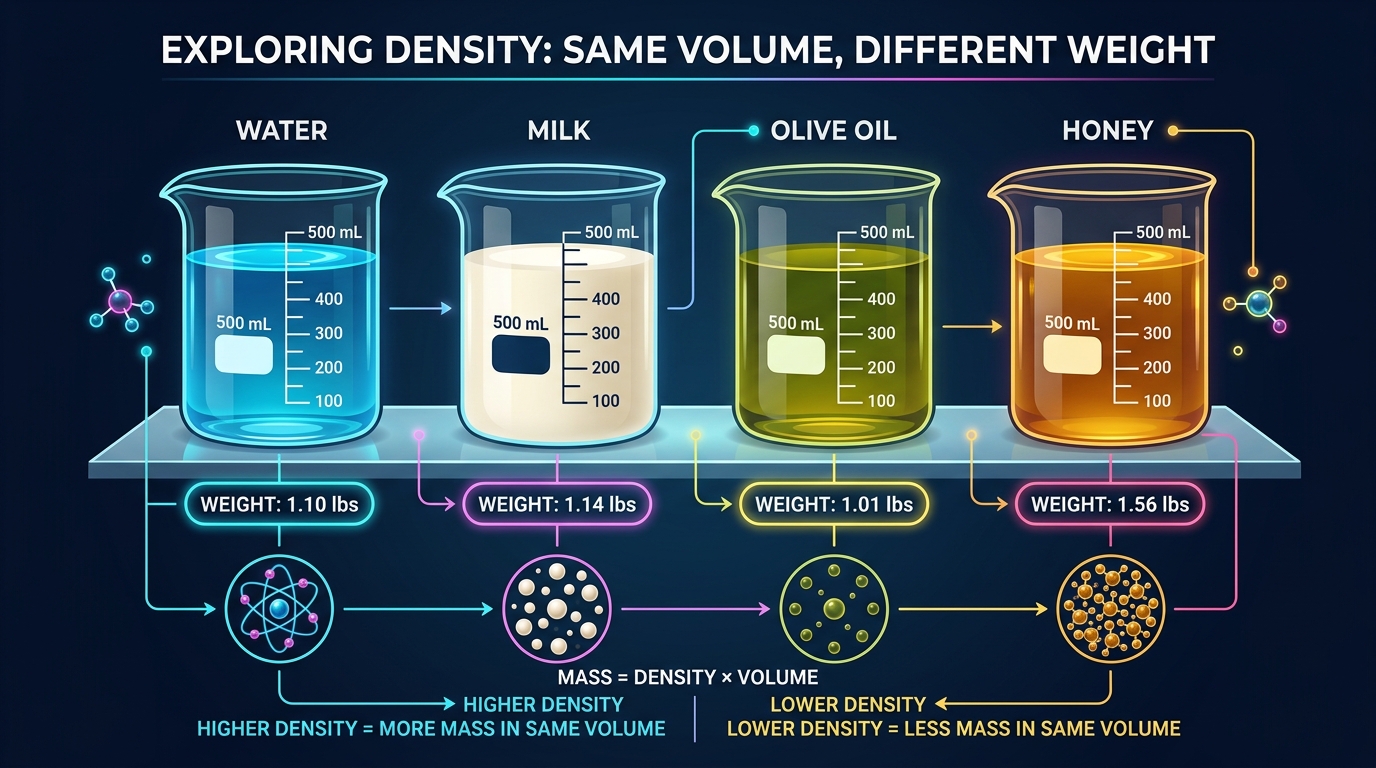
Same volume, different weights: density is the reason 500 mL of honey weighs significantly more than 500 mL of olive oil.
Example Using Water
Convert 500 mL of water to pounds:
Water is the baseline reference for density. At standard conditions, 1 mL of water weighs exactly 1 gram, making it the simplest conversion to calculate.
Example Using Milk
Convert 500 mL of milk to pounds:
Milk is about 3% denser than water because of its dissolved proteins, fats, and lactose. That small density difference adds up quickly at larger volumes.
Example Using Oil
Convert 500 mL of olive oil to pounds:
Oil is less dense than water, which is why it floats on top. The same 500 mL volume weighs nearly 9% less than water.
Example Using Honey
Convert 500 mL of honey to pounds:
Honey is one of the densest common food liquids. The same 500 mL weighs 42% more than water. This is why honey always sinks to the bottom of a glass of water.
Weight Comparison: 500 mL of Different Substances
How Different Densities Change the Result
One of the most eye-opening realizations in measurement science is watching how dramatically density shifts the final weight. I use a simple classroom demonstration that never fails to surprise: I fill four identical containers with 500 mL each of water, vegetable oil, corn syrup, and mercury. Students guess the weights before I place them on a scale. Nobody ever gets mercury right.
What Happens When a Substance Is More Dense?
When a substance has a density greater than 1.0 g/mL, every milliliter packs more mass than water does. Honey at 1.42 g/mL, for instance, squeezes 42% more mass into the same volume. Glycerin at 1.26 g/mL fits 26% more mass. Corn syrup at 1.38 g/mL fits 38% more. The heavier a substance is per unit volume, the more pounds you get from the same number of milliliters. This is especially important for anyone converting mL to weight in recipe scaling or pharmaceutical formulation, where being off by even 10% can produce noticeably different outcomes.
What Happens When a Substance Is Less Dense?
Conversely, when a substance has a density below 1.0 g/mL, each milliliter carries less mass than water. Olive oil at 0.92 g/mL is 8% lighter per unit volume. Rubbing alcohol (isopropanol) at 0.786 g/mL is nearly 22% lighter. Gasoline at approximately 0.75 g/mL is 25% lighter. This means 1,000 mL of gasoline weighs only about 1.65 pounds, while 1,000 mL of water weighs 2.20 pounds. That half-pound difference matters in automotive engineering, fuel logistics, and industrial chemistry.
Why the Same Volume Can Have Different Weights
At the molecular level, density reflects how tightly atoms and molecules are packed together. Water molecules form hydrogen bonds that create a moderately compact structure. Honey is a supersaturated sugar solution where dense sucrose and fructose molecules crowd into every available space. Oil molecules are long hydrocarbon chains that cannot pack as efficiently, leaving more gaps between molecules. These structural differences at the molecular scale translate directly into measurable weight differences at the macroscopic scale you experience on a kitchen or lab scale.
Density Spectrum: Light to Heavy Substances
How to Use the mL to Pounds Calculator
If you prefer not to do the math manually, our mL to pounds calculator handles the entire conversion in seconds. It contains pre-loaded density values for over 50 common substances, so you do not need to look up densities separately. Here is how to use it.
Enter the Volume in mL
Type your volume value into the input field. The calculator accepts any positive number. You can enter whole numbers like 250, decimal values like 37.5, or large quantities like 10000. The calculator handles them all with equal precision.
Enter or Select the Density
Choose from the dropdown menu of common substances, which automatically fills in the correct density. Alternatively, type a custom density value if you are working with a specialized liquid not in the list. The density field accepts values in g/mL format.
Read the Weight in Pounds
The calculator instantly displays the converted weight in pounds (lb). Results update in real time as you change either the volume or the density. The output also shows the intermediate value in grams and kilograms for reference. For quick everyday conversions, this tool eliminates the need for manual calculations entirely.
Try the Calculator Now
Convert any volume of any substance from milliliters to pounds instantly.
Open mL to Pounds CalculatorCommon Mistakes When Converting mL to Pounds
Over the years, I have seen the same four mistakes repeated endlessly. Whether it is students in a university lab, cooks in a commercial kitchen, or hobbyists at home, these errors account for the vast majority of conversion failures.
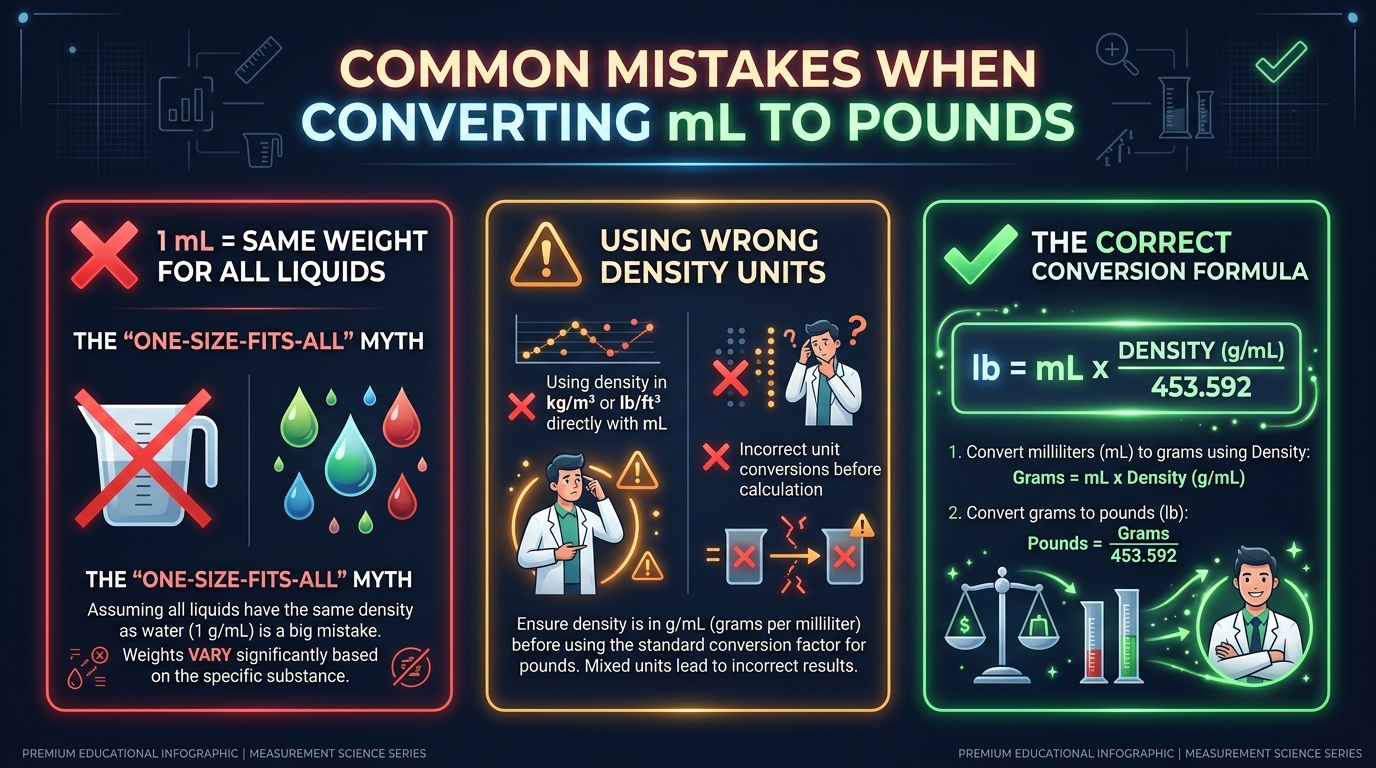
The three most common conversion pitfalls and how to avoid each one.
Assuming 1 mL Always Has the Same Weight
The most widespread error is treating milliliters as if they have a universal weight. People assume 1 mL always weighs 1 gram (or 0.0022 pounds). This is only true for water. For olive oil, 1 mL weighs 0.92 grams. For honey, 1 mL weighs 1.42 grams. That 54% difference between oil and honey makes this assumption dangerous in any precision application.
Using the Wrong Density
Grabbing the density for "oil" when you are measuring canola oil instead of olive oil introduces a small but meaningful error. Canola oil has a density of 0.91 g/mL while olive oil sits at 0.92 g/mL. In small quantities, this is negligible. But at industrial scales of 10,000+ mL, even a 1% density difference means your weight calculation is off by over 100 grams (approximately 0.22 pounds). Always match the density to the exact substance you are measuring.
Mixing Different Density Units
Using a density expressed in kg/m3 (like 1,000 kg/m3 for water) directly in the formula designed for g/mL produces results that are off by a factor of 1,000. I have seen lab reports thrown out because someone copied a density from a physics textbook without converting units first. Always confirm your density is in g/mL before applying it to the formula. If you need help with density-to-mass conversions, use our dedicated tool to handle unit differences automatically.
Rounding the Calculation Too Early
Rounding intermediate values introduces compounding errors. If you round 1.03 g/mL to 1.0 g/mL for "simplicity," you lose 3% of the mass in your calculation. For 500 mL of milk, that is 15 grams or about 0.033 pounds of error. At scale, rounding a 5,000 mL batch translates to a 150-gram or 0.33-pound discrepancy. Always carry at least two decimal places through the entire calculation and only round the final answer.
Frequently Asked Questions About mL to Pounds Conversion
How many pounds are in 1 mL?
The weight of 1 mL depends on the substance. For water, 1 mL weighs approximately 0.0022 pounds. For honey, 1 mL weighs about 0.00313 pounds. For olive oil, 1 mL weighs about 0.00203 pounds. There is no single universal answer because every substance has a different density that determines its weight per unit volume.
How many mL are in 1 pound?
For water, 1 pound equals approximately 453.6 mL. For other substances, divide 453.592 by the density in g/mL. One pound of olive oil (density 0.92 g/mL) equals about 493 mL. One pound of honey (density 1.42 g/mL) equals about 319 mL. The lower the density, the more milliliters fit in a pound.
Is 1 mL equal to 1 gram?
Only for water at standard conditions (approximately 20 degrees Celsius). Water has a density of 1.00 g/mL, making 1 mL weigh exactly 1 gram. For every other substance, 1 mL weighs more or less than 1 gram depending on its density. This misconception is one of the most common errors in volume-to-weight conversions. Learn more about why this assumption fails in our article on why 1 mL does not always equal 1,000 mg.
Does mL to pounds conversion always require density?
Yes, always. Milliliters measure volume (space) and pounds measure weight (mass under gravity). These are fundamentally different physical quantities. Density is the only property that mathematically connects them. Without density, converting mL to pounds is impossible. Any converter that gives you a result without asking for density is silently assuming you are measuring water.
How do you convert mL to pounds of water?
For water specifically, the formula simplifies to: pounds = mL / 453.592. Since water's density is 1.00 g/mL, the density multiplication step produces the same number. For example, 1,000 mL of water equals 1,000 grams, which divided by 453.592 gives you 2.205 pounds. For quick estimates, divide the volume in mL by 454 to get a close approximation in pounds.
Conclusion
Converting milliliters to pounds is a two-step process that hinges entirely on knowing the density of your substance. The formula itself is simple: multiply the volume in mL by the density in g/mL, then divide by 453.592. What makes it tricky is not the math but the assumptions people carry into the calculation. Every substance has a unique density, and treating all liquids as if they were water is the fastest path to inaccurate results.
Whether you are a home cook scaling an international recipe, a lab technician preparing a solution, or a manufacturer verifying batch weights, the principles covered in this guide apply universally. Use our mL to pounds calculator for instant results, or apply the four-step manual process when you want to understand exactly where your numbers come from.
If you found this guide helpful, explore our related conversion tools including the mL to grams converter and the mL to ounces converter for additional measurement conversions that rely on the same density-based methodology.