Quick Overview
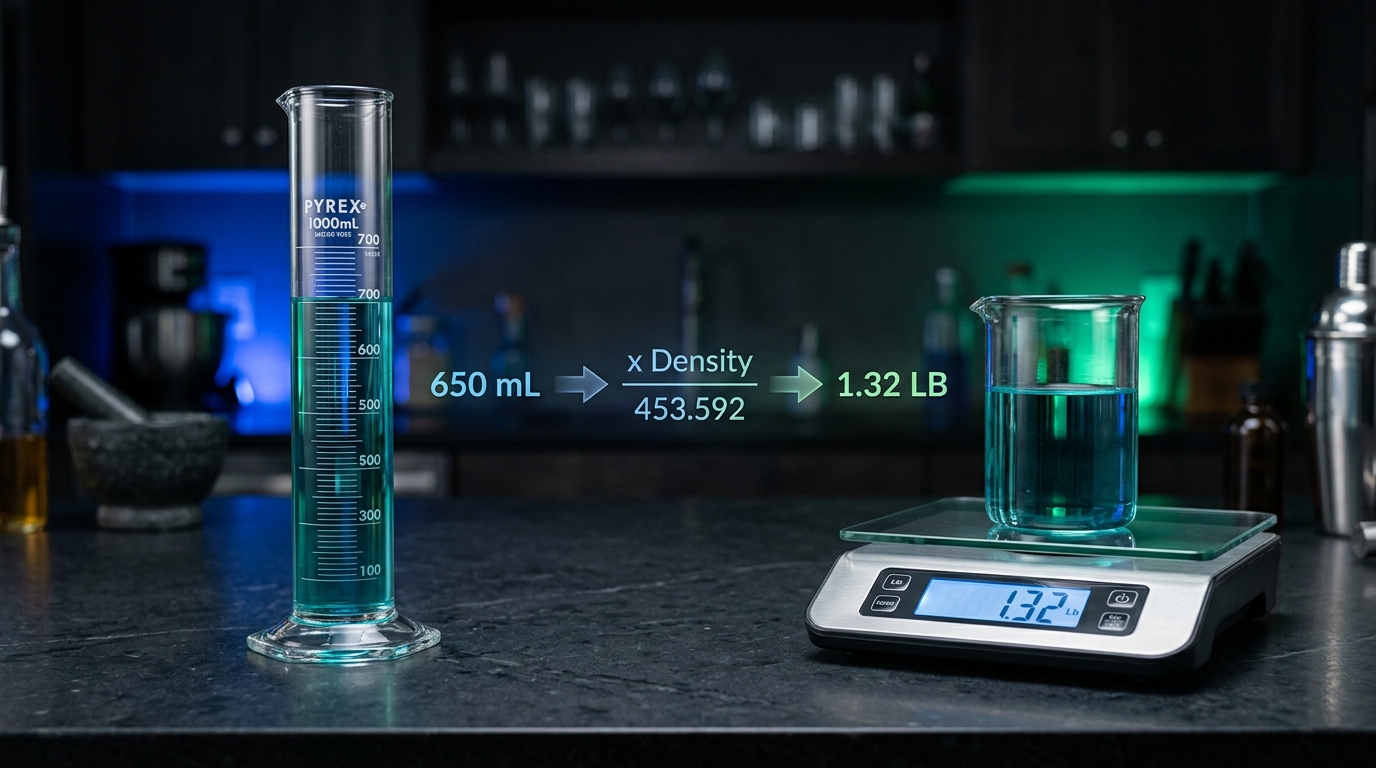
You need to convert milliliters to pounds whenever a liquid volume must be expressed as a weight. This happens more often than you think. Recipes from different countries mix metric and imperial units. Shipping labels demand total package weight. Product packaging lists contents in milliliters while freight carriers bill by the pound. The conversion itself requires density as a bridge between volume and weight, because different substances weigh different amounts for the same volume. In this guide, you will discover every major scenario where this conversion matters, learn what information you need for accuracy, and find out when using our mL to pounds calculator saves time and prevents costly errors.
Why Would You Convert mL to Pounds?
At first glance, the question seems odd. Why would you need to take a volume measurement and turn it into a weight? The short answer is that the real world does not respect the boundaries between measurement systems. Metric volumes and imperial weights constantly collide in kitchens, warehouses, laboratories, and manufacturing floors. Let me break down the four primary reasons.
When Volume Measurements Need to Be Expressed as Weight
Many industries operate in weight-based systems. Freight companies charge by the pound. Nutritional labels report ingredient weights. Quality control departments track batch masses. When your source data gives you a volume in milliliters but the destination requires a weight in pounds, you have no choice but to convert. I dealt with this firsthand when a cosmetics company reformulated a moisturizer. Their production notes recorded everything in milliliters, but regulatory paperwork for the US market required ingredient weights in pounds per batch. Without the conversion, they could not submit their documentation.
When a Recipe Uses Different Measurement Units
International recipes are notorious for mixing systems. A French pastry recipe might call for 300 mL of cream, while an American kitchen scale reads only in pounds and ounces. You cannot simply pour 300 mL onto a scale set to pounds and read the display without understanding what that volume actually weighs. Cream has a density of about 1.01 g/mL, so 300 mL of cream weighs roughly 303 grams, which is 0.67 pounds. Skip that step, and your Chantilly might not set properly. For more about how milliliter-to-gram conversions work in practice, our dedicated tool walks through the math.
When Product Quantities Are Listed by Weight
Walk through any grocery store and you will notice a pattern. Liquid products often display volume on the front label (500 mL, 750 mL) but list net weight on the nutritional panel or shipping carton. This dual-labeling creates a constant need for conversion. A buyer comparing prices between a 500 mL bottle and a 1-pound container needs to know whether those two packages hold the same amount of product. Without converting one unit to the other, price-per-unit comparisons are impossible.
When Shipping or Packaging Requires Weight
Every package shipped commercially needs a declared weight. Carriers calculate fees, aircraft load limits, and truck capacities based on weight, not volume. If you manufacture a liquid product measured in milliliters, you must convert that volume to a weight before filling out shipping documents. A single 750 mL bottle of olive oil weighs about 1.52 pounds. Multiply that across a pallet of 500 bottles, and you are looking at roughly 760 pounds of product weight alone, before packaging materials.
When Do You Need mL to Pounds Conversion?
Common Situations That Require mL to Pounds Conversion
Theory is useful, but real-world applications tell the full story. I have encountered this conversion across wildly different industries. Here are the five areas where it comes up the most.
Cooking and Baking
Professional bakers weigh everything. Home cooks increasingly follow the same approach because weight measurements produce more consistent results than volume scoops. When a European recipe calls for 200 mL of melted butter but your scale reads in pounds, you need the conversion. Melted butter has a density of about 0.91 g/mL, so 200 mL equals roughly 182 grams or 0.40 pounds. Without that step, you are guessing, and baking does not forgive guesswork. A cake that should rise to three inches might barely clear two if the butter is off by 20 percent.
Food and Ingredient Measurements
Beyond recipes, food manufacturers deal with this conversion during ingredient procurement. A supplier sells honey by the pound. Your formulation calls for 500 mL per batch. Honey weighs about 1.42 g/mL, so 500 mL equals 710 grams or 1.57 pounds. If you order one pound of honey thinking it covers the recipe, you will come up short by 0.57 pounds. That error cascades through an entire production run. Understanding how density drives the mL to pounds calculation prevents this kind of costly mistake.
Shipping and Packaging
Every shipping label, customs declaration, and freight bill uses weight. If you sell liquids in milliliter bottles, you must calculate the total weight of your shipment before it leaves your facility. I once worked with a candle maker who shipped 500 mL jars of scented wax melts. She assumed each jar weighed about a pound because "water and wax are similar." The wax blend actually had a density of 0.82 g/mL, making each jar about 0.90 pounds of product. Over a 200-jar shipment, her estimate was off by 20 pounds, enough to trigger a recalculation of freight costs.
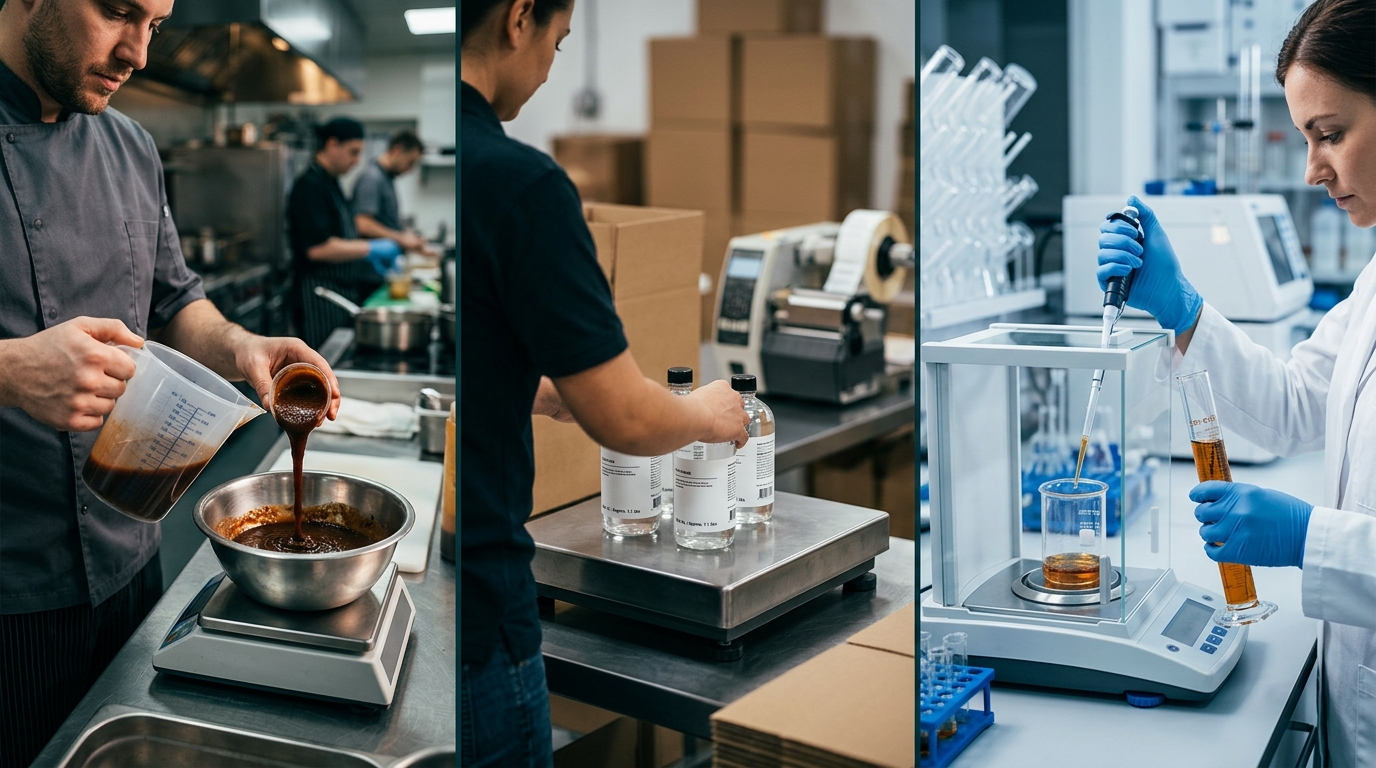
From professional kitchens to shipping docks and research labs, converting milliliters to pounds is an everyday necessity across multiple industries.
Manufacturing and Production
Manufacturing plants track raw materials by weight for inventory control, cost accounting, and quality assurance. When a production line consumes 10,000 mL of a chemical additive per shift, management needs that figure in pounds to reconcile with purchase orders denominated in pounds. Chemical additives range in density from 0.7 g/mL (light solvents) to over 2.0 g/mL (heavy metal solutions). Using water's density as a shortcut could overestimate or underestimate actual consumption by 30 percent or more.
Laboratory and Scientific Work
Researchers often need to report sample masses alongside volumetric measurements. A biologist extracting 50 mL of plant oil for analysis might need to record the sample weight in pounds for a report sent to an American regulatory agency. Lab-grade olive oil at 0.918 g/mL means that 50 mL sample weighs 45.9 grams or about 0.101 pounds. Precision matters in scientific contexts. You can verify quick conversions using our density calculator to ensure your published data is accurate.
Where mL to Pounds Conversion Is Used Most
When Is mL to Pounds Conversion Useful in Cooking?
Cooking is probably the single most common reason people search for this conversion. The intersection of metric and imperial recipes creates confusion daily in kitchens around the world. Here is when the conversion actually matters.
Converting Liquid Ingredients for Recipes
European and Asian recipes typically use milliliters. American recipes lean toward cups, ounces, and pounds. When you follow a recipe from a different region, you encounter mismatches constantly. Converting 750 mL of coconut milk to pounds requires knowing that coconut milk has a density of about 1.01 g/mL. That gives you 757.5 grams, or 1.67 pounds. If the original recipe doubles, you need 3.34 pounds of coconut milk. This kind of precision becomes even more critical in commercial kitchens scaling recipes for 200-plus servings at a time.
Measuring Ingredients by Weight Instead of Volume
Professional pastry chefs almost universally prefer weight measurements over volume. Weight eliminates variables like how tightly you pack a measuring cup or how much air sits between granules. When your recipe says 250 mL of maple syrup and you want the weight instead, you multiply by maple syrup's density of 1.33 g/mL. That is 332.5 grams or 0.73 pounds. Working in weight guarantees your recipe produces the same result every single time, regardless of who measures the ingredients.
Adjusting Recipes for Different Measurement Systems
Some cooks end up converting back and forth between systems. A friend of mine runs a food blog that publishes every recipe in both metric and imperial. She has to convert every liquid ingredient from milliliters to ounces and pounds to ensure accuracy in both versions. For thick liquids like honey, sour cream, or condensed milk, the difference between volume and weight is dramatic enough that skipping the conversion would give readers the wrong amount and produce failed recipes.
Common Cooking Liquid Conversions (250 mL)
| Ingredient | Density (g/mL) | Weight (grams) | Weight (pounds) |
|---|---|---|---|
| Water | 1.00 | 250.0 | 0.55 lb |
| Whole Milk | 1.03 | 257.5 | 0.57 lb |
| Heavy Cream | 1.01 | 252.5 | 0.56 lb |
| Olive Oil | 0.92 | 230.0 | 0.51 lb |
| Honey | 1.42 | 355.0 | 0.78 lb |
| Maple Syrup | 1.33 | 332.5 | 0.73 lb |
| Vegetable Oil | 0.91 | 227.5 | 0.50 lb |
| Soy Sauce | 1.17 | 292.5 | 0.64 lb |
When Is mL to Pounds Conversion Needed for Products?
Consumer products constantly blur the line between volume and weight labeling. Understanding when to convert helps shoppers, manufacturers, and retailers make accurate comparisons and informed decisions.
Comparing Product Quantities
Imagine standing in a store looking at two bottles of cooking oil. One label reads 750 mL. The other reads 1.5 pounds. Which one gives you more product? To compare, you need to convert one to the other. Olive oil at 0.92 g/mL means 750 mL weighs about 690 grams or 1.52 pounds. That is almost identical to the 1.5-pound bottle. Without the conversion, you might assume the larger number (750) means more product when in reality the two are nearly equal.
Checking Package Weight
Online retailers frequently list product weights for shipping calculations. A customer buying a 500 mL bottle of shampoo wants to know how much it weighs for shipping estimates. Shampoo density varies between 1.01 and 1.05 g/mL depending on the formulation. Using 1.03 g/mL as an average, 500 mL of shampoo weighs about 515 grams or 1.14 pounds. Add the bottle weight (typically 40 to 60 grams), and the total shipped weight is roughly 1.26 pounds.
Converting Liquid Product Volume to Shipping Weight
E-commerce businesses shipping liquids must calculate accurate weights to set shipping rates. Underestimate, and you absorb extra freight costs. Overestimate, and your shipping prices scare away customers. A business selling 250 mL bottles of essential oils needs precise conversions. Lavender essential oil has a density of about 0.88 g/mL, making each bottle weigh 220 grams or 0.49 pounds of product. With packaging, each unit ships at roughly 0.65 pounds. Multiply that across thousands of orders, and even small conversion errors add up to significant cost differences.
Same Volume, Different Product Weights (500 mL)
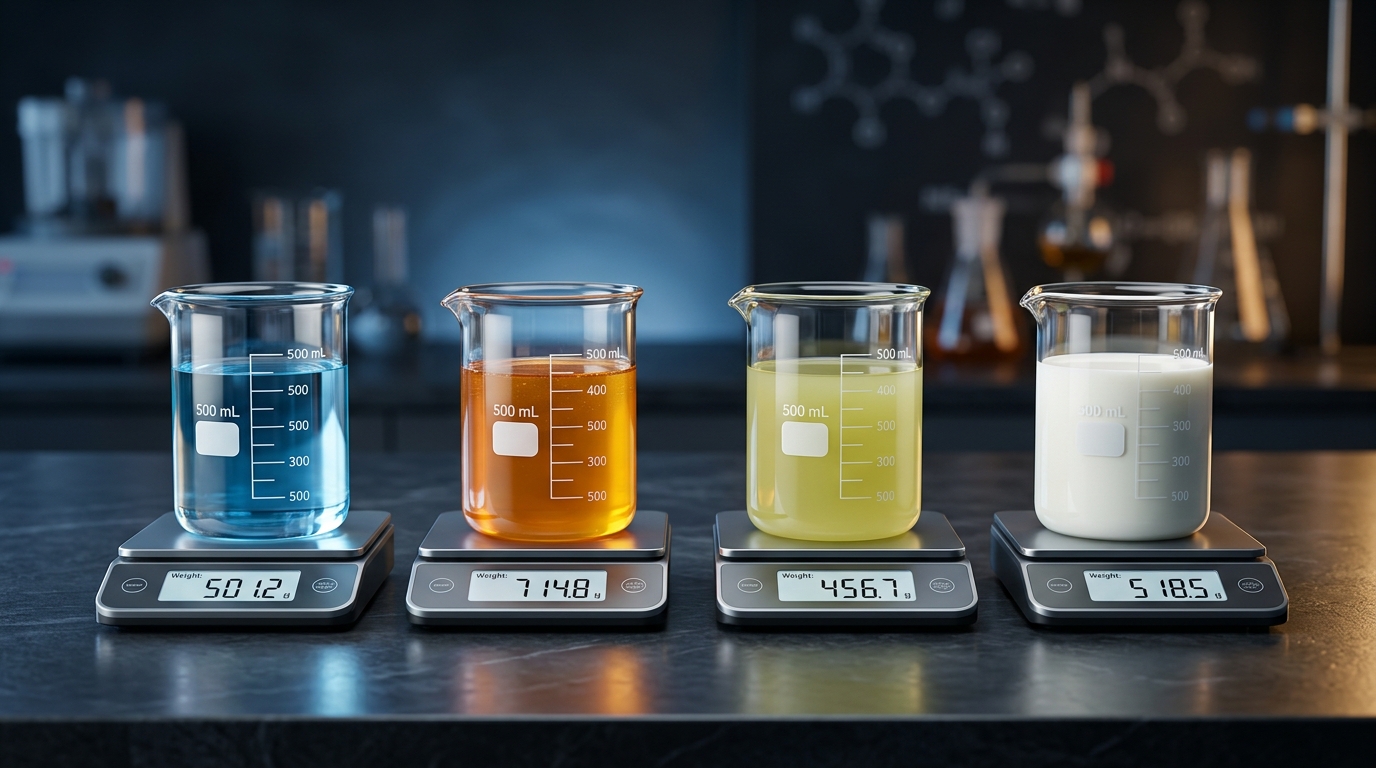
Four beakers holding the exact same volume (500 mL) of different substances. Each scale reads a different weight because density varies between liquids.
When Does the Substance Matter?
This is the question that separates a rough estimate from an accurate conversion. The substance you are measuring determines everything about the final weight. Skip this step and your numbers will be wrong.
Why Different Substances Have Different Weights
At the molecular level, substances differ in how tightly their atoms and molecules pack together. Water molecules form hydrogen bonds that create a moderately dense structure at 1.00 g/mL. Honey is a supersaturated sugar solution with heavy sucrose and fructose molecules crammed into every available space, reaching 1.42 g/mL. Oil molecules are long hydrocarbon chains that leave gaps between them, sitting at 0.92 g/mL. These structural differences at the atomic scale produce the measurable weight differences you see on a kitchen or laboratory scale. Every liquid has its own unique density fingerprint.
When You Need the Substance's Density
You need the exact density any time accuracy matters. In casual cooking, a rough estimate might be acceptable. But in pharmaceutical compounding, quality control testing, or regulatory reporting, even a 5% error can have consequences. A pharmacist preparing a liquid compound needs the exact density of the active ingredient. A food manufacturer must report accurate weights on nutrition labels. A laboratory submitting data to a regulatory agency cannot round to the nearest "close enough." In every one of these scenarios, you need to look up or measure the actual density of your substance before converting.
When a Water-Based Approximation May Be Appropriate
Not every situation demands laboratory precision. If you are quickly estimating how much a bottle of juice weighs for packing a suitcase, using water's density of 1.00 g/mL gets you close enough. Fruit juices typically range from 1.03 to 1.06 g/mL, so the error is only 3 to 6 percent. For a 500 mL bottle, that is a difference of about 15 to 30 grams, or roughly 0.03 to 0.07 pounds. If that margin is acceptable for your purpose, the water approximation saves time. However, for substances with densities far from water (oils, syrups, alcohols), this shortcut fails badly. Learn more about this distinction in our guide on why density matters in conversions.
Error When Using Water Density for Other Substances
When Should You Use an mL to Pounds Calculator?
Manual math is fine for occasional one-off conversions, but there are situations where a calculator is not just helpful but essential. Knowing when to reach for the tool saves time and prevents errors.
When You Need a Quick Conversion
Speed matters in commercial kitchens during service, on warehouse floors during loading, and in labs during time-sensitive experiments. Pulling up our mL to pounds calculator gives you an answer in seconds. Type the volume, select or enter the density, and read the result. No formula memorization required. No risk of misplacing a decimal point under pressure. I have watched a chef convert six different liquid ingredients from milliliters to pounds in under 90 seconds using the calculator, something that would take five minutes with pen and paper.
When You Are Converting Different Substances
A single recipe or project might involve water, oil, honey, cream, and soy sauce. Each has a different density. Doing five separate manual calculations introduces five opportunities for error. A calculator with pre-loaded density values lets you switch between substances with a dropdown selection. You enter the volume once, change the substance, and get a new weight instantly. This is especially valuable in manufacturing environments where a single production batch might involve 10 or more liquid ingredients.
When Manual Calculations Are Time-Consuming
Converting 500 mL of a single substance is straightforward. But what about converting 47 different liquid ingredients across three production batches, each with different volumes and densities? At that scale, manual calculations become not just tedious but error-prone. Fatigue leads to transposed digits and forgotten decimal places. A calculator eliminates human arithmetic errors entirely. For bulk conversions, you can also cross-reference results using our mL to ounces converter when imperial sub-unit precision is needed.
Try the Calculator Now
Convert any volume of any substance from milliliters to pounds instantly with pre-loaded density values for 50+ substances.
Open mL to Pounds CalculatorWhat Information Do You Need for an Accurate Conversion?
Every mL to pounds conversion requires exactly three pieces of information. Miss one and your result will be inaccurate. Here is what you need and where to find it.
Volume in Milliliters
This is your starting measurement. Use a graduated cylinder, volumetric flask, or calibrated measuring cup for best accuracy. Digital measuring devices can provide precision to the nearest 0.1 mL. For packaged products, the volume is printed on the label. If your source measurement is in liters, multiply by 1,000 to get milliliters. If it is in fluid ounces, multiply by 29.5735. Precision at this stage directly affects the accuracy of your final result.
Substance or Material
You must identify exactly what substance you are converting. "Oil" is not specific enough. Olive oil (0.92 g/mL), coconut oil (0.93 g/mL), and sesame oil (0.92 g/mL) have slightly different densities. In casual cooking, these small differences may not matter. But in pharmaceutical or industrial settings, the exact substance determines the exact density, which determines the exact weight. Always be as specific as possible about what you are measuring.
Density of the Substance
Density is the bridge that connects volume to weight. It tells you how much mass occupies each milliliter. Common density sources include product data sheets, chemistry reference databases, and the labels on laboratory-grade chemicals. The standard unit for this conversion is grams per milliliter (g/mL). If your density is given in other units, convert it first. Kilograms per cubic meter (kg/m3) requires dividing by 1,000. Specific gravity for liquids is numerically equal to density in g/mL at standard conditions.
Three Requirements for Accurate mL to Pounds Conversion
Common Situations Where mL to Pounds Conversion Can Be Misleading
Conversions can mislead when people carry incorrect assumptions into the process. Knowing where mistakes happen is just as important as knowing how to do the math correctly. Here are the three biggest traps.
Treating mL as a Weight Measurement
Milliliters measure space, not weight. They tell you how much room a substance takes up, nothing more. Treating 100 mL as if it automatically equals 100 grams or 0.22 pounds only works for water. For honey, 100 mL weighs 142 grams (0.31 lb). For rubbing alcohol, 100 mL weighs only 79 grams (0.17 lb). The difference is massive. Anyone who assumes mL and grams are interchangeable will produce incorrect weight conversions for every substance except water.
Assuming Every Substance Has the Same Density
This is the most common mistake in volume-to-weight conversion. I have seen it happen in professional settings more times than I can count. A warehouse manager assumed all liquids weigh about the same as water and estimated an entire pallet of glycerin bottles at 1.00 g/mL instead of the actual 1.26 g/mL. The shipment was 26% heavier than his paperwork declared. The carrier flagged it during loading, delayed the delivery by a day, and charged a fee for the weight discrepancy. Every substance has a unique density, and that density determines its weight per milliliter.
Using Water's Density for Another Substance
This is a specific version of the previous mistake and it deserves its own warning. Many quick online converters default to water's density without telling you. They accept a volume in mL, apply a density of 1.00 g/mL silently, and output a weight. If you are converting water, the result is correct. If you are converting anything else, the result is wrong. For motor oil at 0.87 g/mL, the error is 13%. For corn syrup at 1.38 g/mL, the error is 38%. Always check whether a converter asks for substance or density. If it does not, it is assuming water. Our mL to pounds calculator always asks for the substance because accuracy demands it.
Actual Weight vs Water-Based Estimate (1,000 mL)
Frequently Asked Questions About mL to Pounds Conversion
Why would you convert mL to pounds?
You convert mL to pounds whenever you need to express a liquid volume as a weight. This happens in cooking when recipes mix metric and imperial units, in shipping when freight companies require declared weights, in manufacturing when production records need weight-based tracking, and in product labeling when comparing quantities listed in different units. The conversion bridges two fundamentally different measurement types using density as the connecting factor.
Can mL be converted to pounds for every substance?
Yes, as long as you know the density of that substance. Every physical material has a density that relates its volume to its mass. Whether the substance is a liquid like water, a thick syrup like honey, or even a powder measured by volume, you can convert its milliliter volume to a weight in pounds by multiplying by density and dividing by 453.592. The formula works universally because it relies on fundamental physical properties.
Do you always need density to convert mL to pounds?
Yes, always. Milliliters measure volume and pounds measure weight. These are fundamentally different physical quantities. Density is the only property that mathematically connects them. Any tool that converts mL to pounds without asking for density is silently assuming you are measuring water (density = 1.00 g/mL). For any other substance, you need the actual density to get an accurate result.
Is converting mL to pounds useful for cooking?
Absolutely. It is one of the most common cooking-related conversions. International recipes frequently use milliliters for liquids, while American kitchens often measure in pounds and ounces. Converting accurately ensures your recipes turn out correctly every time. Professional bakers especially rely on weight measurements because they are more precise and consistent than volume scoops. For a detailed walkthrough, see our cooking ingredients conversion guide.
Can an mL to pounds calculator convert different substances?
Yes, a well-designed calculator includes density values for many common substances. Our mL to pounds calculator has pre-loaded densities for over 50 substances including water, milk, honey, olive oil, gasoline, and various chemicals. You select your substance from a dropdown, enter the volume, and the calculator applies the correct density automatically. For substances not in the list, you can enter a custom density value.
Conclusion
The need to convert milliliters to pounds shows up in more places than most people expect. Cooking, shipping, product comparison, manufacturing, and laboratory work all create situations where a volume measured in milliliters must be expressed as a weight in pounds. The conversion itself follows a simple formula: multiply the volume by the substance density, then divide by 453.592. But the real challenge is not the math. It is knowing when the conversion is necessary and ensuring you use the correct density for your specific substance.
Every liquid has its own density fingerprint, and treating all substances as if they weigh the same as water leads to errors ranging from minor inconveniences to costly mistakes. Whether you are a home cook scaling a European recipe, an e-commerce seller calculating shipping weights, or a lab technician preparing a regulatory submission, the principles in this guide apply across every scenario.
For quick and accurate conversions, our mL to pounds calculator handles the work instantly with built-in density values for dozens of common substances. For broader measurement needs, explore our mL to grams converter and mL to kilograms converter for additional tools built on the same density-based methodology that makes accurate volume-to-weight conversion possible.