Executive Summary
Milliliters measure volume while kilograms measure mass. Converting between them requires knowing the density of your substance. The formula is straightforward: kg = (mL x density) / 1,000. For water at room temperature, 1,000 mL equals approximately 1 kg because water has a density close to 1.0 g/mL. However, 1,000 mL of olive oil weighs only about 0.92 kg, while 1,000 mL of honey weighs roughly 1.42 kg. In this guide, you will learn the exact formula, walk through real calculations for common liquids, understand density unit conversions, and avoid the most frequent errors people make. If you need an instant answer, use our mL to kg calculator with built-in density values for dozens of substances.
What Do mL and kg Measure?
Before diving into conversion math, it helps to understand what these two units actually represent. A surprising number of errors come from treating milliliters and kilograms as interchangeable. They are not. They describe fundamentally different physical quantities.
What Is a Milliliter (mL)?
A milliliter is a unit of volume in the metric system. One milliliter equals one cubic centimeter (1 cm3) or one-thousandth of a liter. When you fill a small medicine dropper, that dropper holds roughly 1 mL of liquid. Milliliters tell you how much space a substance occupies. They say nothing about how heavy that substance is. A milliliter of air and a milliliter of mercury take up exactly the same space, but their masses differ by a factor of over 13,000.
What Is a Kilogram (kg)?
A kilogram is the base unit of mass in the International System of Units (SI). One kilogram equals 1,000 grams. When you step on a bathroom scale and it reads 70 kg, the scale is reporting how much matter your body contains (technically, it measures weight, but on Earth these values are effectively equivalent). Kilograms measure how much stuff is packed into an object, regardless of that object's shape or volume.
Why mL Cannot Be Directly Converted to kg
Because milliliters measure space and kilograms measure mass, there is no universal fixed ratio between them. Asking "how many kg is 500 mL" without specifying the substance is like asking "how many hours is 100 kilometers" without specifying the speed. You need a connecting factor. For volume-to-mass conversions, that connecting factor is density. Density tells you how many grams of a substance fit into each milliliter of space. Once you know that number, the rest of the math takes less than 30 seconds. If you have worked with our guide on why density matters before, this concept will feel familiar.
Volume vs. Mass: Two Different Physical Properties
What Information Do You Need to Convert mL to kg?
Before you touch a calculator, you need exactly two pieces of information. Miss either one and the conversion cannot produce an accurate result.
Volume in Milliliters
The first value is the volume of the substance you want to convert. This might come from a measuring cup, a graduated cylinder, a recipe, or a product label. Make sure you are reading the volume at the bottom of the meniscus (the curved surface of the liquid) for accurate measurements. Even a 5 mL error in a 100 mL measurement introduces a 5% discrepancy in your final mass calculation.
Density of the Substance
The second value is the density of the substance, expressed in grams per milliliter (g/mL). Density describes how tightly packed the molecules of a substance are. You can find density values from material safety data sheets, scientific databases, textbooks, or our guide on finding liquid density. Common densities include water at 1.00 g/mL, whole milk at 1.03 g/mL, olive oil at 0.92 g/mL, and honey at 1.42 g/mL.
Why the Substance Matters
Every substance has a unique density because its molecules have different sizes, masses, and spacing patterns. Water molecules are relatively small and pack together moderately. Honey contains dissolved sugars that increase its mass per unit volume dramatically. Olive oil molecules are large but relatively light, making oil less dense than water. This is why oil floats on water and why equal volumes of different liquids produce different kilogram values.
Common Substance Densities (at ~20 degrees C)
| Substance | Density (g/mL) | 500 mL in kg | 1,000 mL in kg |
|---|---|---|---|
| Water | 1.00 | 0.500 kg | 1.000 kg |
| Whole milk | 1.03 | 0.515 kg | 1.030 kg |
| Olive oil | 0.92 | 0.460 kg | 0.920 kg |
| Honey | 1.42 | 0.710 kg | 1.420 kg |
| Ethanol | 0.789 | 0.395 kg | 0.789 kg |
| Mercury | 13.53 | 6.765 kg | 13.530 kg |
What Is the Formula for Converting mL to kg?
The conversion formula is elegant in its simplicity. Once you see it written out, you will wonder why anyone finds mL to kg conversion confusing. The entire process uses basic multiplication and division.
mL to kg Conversion Formula
What Each Variable in the Formula Means
Volume (mL) is the amount of liquid you want to convert. Density (g/mL) is the mass of one milliliter of that specific substance. The division by 1,000 converts the intermediate gram result into kilograms. When you multiply mL by g/mL, the mL units cancel out and you are left with grams. Since 1 kilogram contains 1,000 grams, dividing by 1,000 shifts from grams to kilograms.
How the Formula Converts Grams to Kilograms
This two-part process is what trips most people up. The multiplication step (mL x density) gives you mass in grams, not kilograms. Many beginners stop there and report their answer in grams, which technically is not wrong but fails to answer the question. The final division by 1,000 is the step that completes the journey from volume in milliliters to mass in kilograms. Think of it as two back-to-back conversions: mL to grams, then grams to kg. Use our mL to kg calculator to verify your manual calculations instantly.
Two-Step Formula Flow: mL to Grams to Kilograms
How to Convert mL to kg Step by Step
Theory becomes real when you apply it. I have used this exact five-step method hundreds of times in product development labs and it has never produced an inaccurate result. Follow each step in order and your conversion will be correct every time.
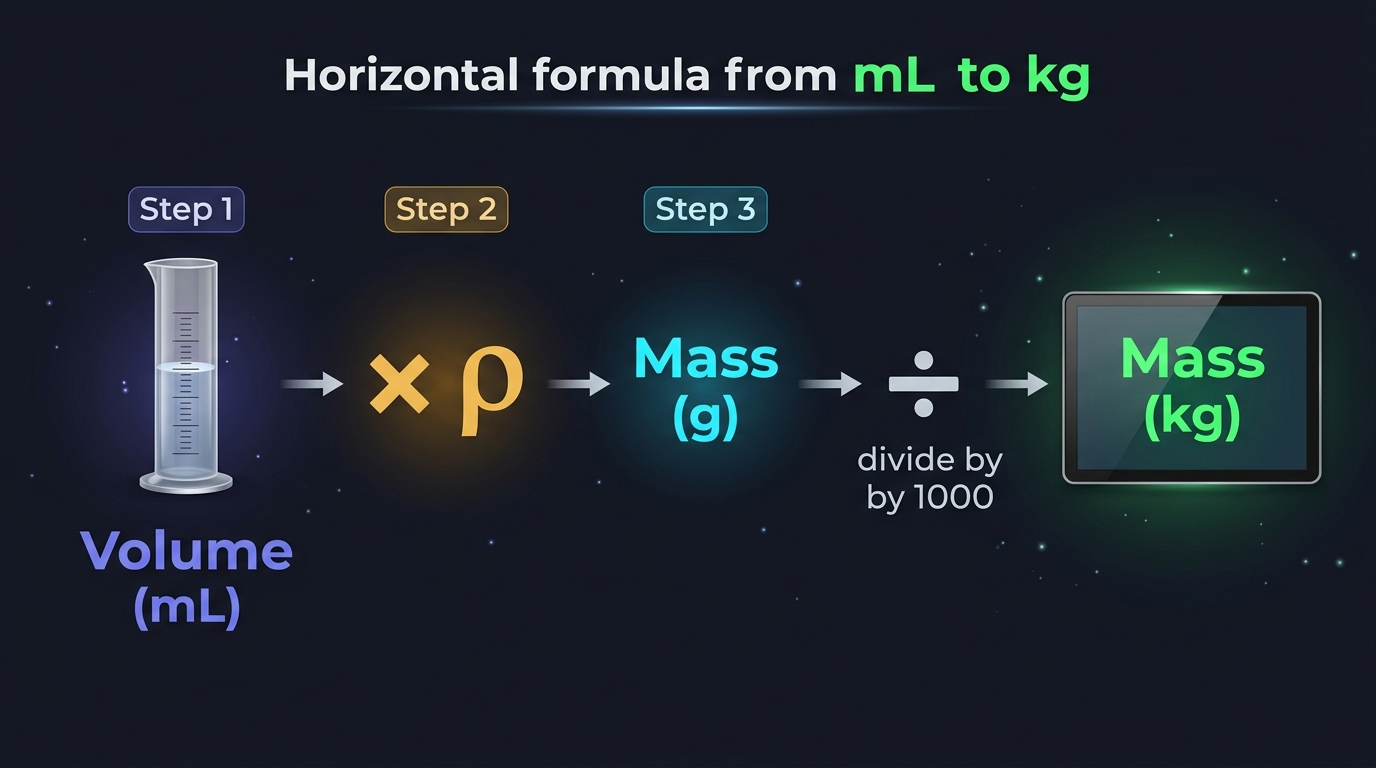
The conversion pipeline: volume in mL is multiplied by density to get grams, then divided by 1,000 to reach kilograms.
Step 1: Determine the Volume in mL
Write down or confirm the volume you want to convert. If you are measuring liquid, use a graduated cylinder or a calibrated measuring cup. For our example, let us start with 750 mL of olive oil.
Step 2: Find the Substance's Density
Look up the density of your substance. Olive oil has a density of approximately 0.92 g/mL at room temperature. Make sure the density is expressed in g/mL. If your source uses different units, convert them first (we cover that in the next section).
Step 3: Multiply Volume by Density
Multiply the volume by the density to get mass in grams. In our example: 750 mL x 0.92 g/mL = 690 grams. The mL units cancel, leaving you with grams.
Step 4: Convert Grams to Kilograms
Divide your gram result by 1,000 to get kilograms. In our example: 690 g / 1,000 = 0.69 kg. That is your final answer.
Step 5: Check the Final Result
Always do a sanity check. Olive oil is lighter than water, so 750 mL of olive oil should weigh less than 750 mL of water (which would be 0.75 kg). Our answer of 0.69 kg is indeed less than 0.75 kg, confirming the result makes physical sense. You can double-check by plugging the same values into our mL to kg converter.
Five-Step Conversion Process: 750 mL Olive Oil to kg
How to Use Different Density Units
Not every source lists density in g/mL. Some scientific references use kg/L, others use kg/m3. Knowing how to convert between these density units ensures you never plug the wrong number into the formula.
Converting Using Density in g/mL
This is the simplest scenario because the formula uses g/mL directly. Multiply your volume in mL by the density in g/mL to get grams, then divide by 1,000 for kilograms. No extra conversion needed. Most food and cooking references express density this way.
Converting Using Density in kg/L
Here is a convenient shortcut: since 1 L = 1,000 mL, the numerical value of density in kg/L is identical to its value in g/mL. Water has a density of 1.0 kg/L, which is the same as 1.0 g/mL. If your density source uses kg/L, you can plug that number directly into the formula with no modification.
Converting Density from kg/m3 to g/mL
Many engineering and physics references use kg/m3. To convert to g/mL, simply divide by 1,000. For example, water has a density of approximately 998 kg/m3 at 20 degrees C. Dividing by 1,000 gives 0.998 g/mL. This is important because using 998 as a density value without converting would make your answer 1,000 times too large.
Density Unit Conversion Quick Reference
| Source Unit | How to Convert to g/mL | Example |
|---|---|---|
| g/mL | Use directly (no conversion) | 1.03 g/mL = 1.03 g/mL |
| kg/L | Same numerical value | 0.92 kg/L = 0.92 g/mL |
| kg/m3 | Divide by 1,000 | 1,420 kg/m3 = 1.42 g/mL |
| g/cm3 | Same numerical value | 0.789 g/cm3 = 0.789 g/mL |
| Specific gravity | Same numerical value (for liquids) | SG 1.03 = 1.03 g/mL |
How to Convert mL to kg for Water
Water is the benchmark substance for mL to kg conversions. Because water has a density very close to 1.0 g/mL at room temperature, the math becomes almost trivial. Water serves as the reference point against which all other substances are measured.
Why Water Is the Simplest Example
When density equals 1.0 g/mL, the formula simplifies beautifully: kg = mL / 1,000. No intermediate multiplication needed. One milliliter of water weighs approximately one gram, so converting to kilograms is just a matter of moving the decimal point three places to the left.
100 mL of Water to kg
500 mL of Water to kg
1,000 mL of Water to kg
This is the only substance where 1,000 mL closely equals exactly 1 kg. For all other substances, the answer will differ.
How to Convert mL to kg for Different Liquids
Here is where the concept truly comes alive. When you compare the same volume of different liquids, the mass differences are striking. I have seen students stare at these results in disbelief during lab demonstrations.
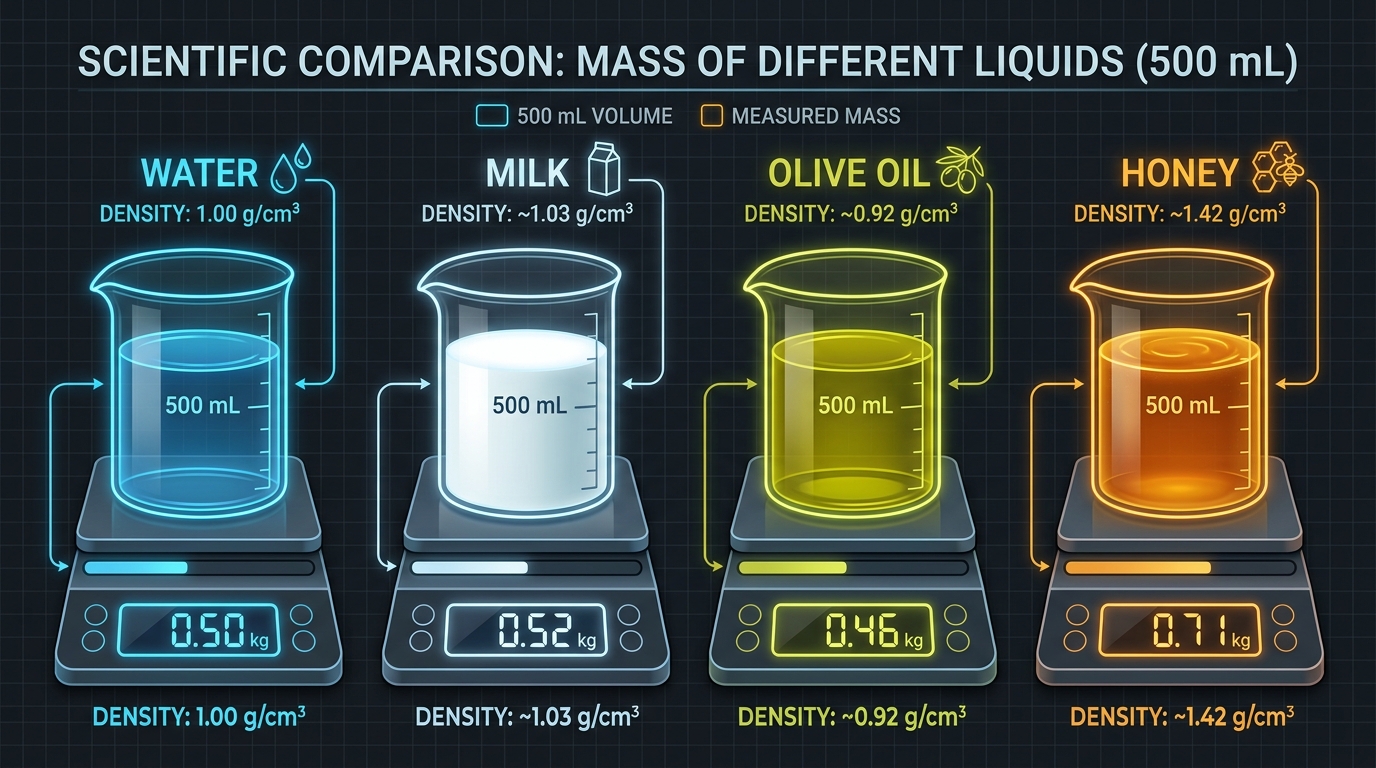
Same volume (500 mL), dramatically different masses. Density determines the kilogram value for every substance.
Converting Milk from mL to kg
Whole milk has a density of approximately 1.03 g/mL due to dissolved proteins, fats, and lactose. For 500 mL of milk: 500 x 1.03 = 515 g, which equals 0.515 kg. Milk is only slightly heavier than water, which makes sense because it is mostly water with a few percent dissolved solids. Our cooking ingredients conversion guide covers even more kitchen liquids.
Converting Olive Oil from mL to kg
Olive oil has a density of roughly 0.92 g/mL. For 500 mL of olive oil: 500 x 0.92 = 460 g, which equals 0.46 kg. This is noticeably less than water. Olive oil is lighter because its long-chain fatty acid molecules are less densely packed than water molecules. This is also why oil floats when poured into water.
Converting Honey from mL to kg
Honey is one of the densest common kitchen liquids at about 1.42 g/mL. For 500 mL of honey: 500 x 1.42 = 710 g, which equals 0.71 kg. Honey is 42% heavier than the same volume of water. The high sugar concentration gives honey its remarkable density.
Comparing the Same Volume of Different Liquids
500 mL of Each Liquid: Mass Comparison (kg)
Worked mL to kg Conversion Examples
Let me walk you through four complete examples using different volumes and substances. Each example follows the same five-step process from the section above.
Example: 250 mL to kg
Ethanol is significantly lighter than water, so 250 mL weighs less than a quarter kilogram.
Example: 750 mL to kg
Milk is only slightly heavier than water, so 750 mL of milk weighs about 23 grams more than 750 mL of water.
Example: 1,500 mL to kg
Even at 1,500 mL (1.5 liters), olive oil weighs less than 1.5 kg because it is lighter than water.
Example: 2,500 mL to kg
Notice how 2,500 mL of honey is over 3.5 kg, far heavier than 2.5 kg (what you would get if honey had the same density as water).
Does 1,000 mL Always Equal 1 kg?
This is the single most common misconception in volume-to-mass conversion. The answer is no. Only one substance makes this equation approximately true, and understanding why protects you from expensive errors.
When 1,000 mL Is Approximately 1 kg
The only substance where 1,000 mL closely equals 1 kg is pure water at roughly 4 degrees Celsius (the temperature at which water reaches its maximum density of 0.99997 g/mL). At typical room temperature (20 to 25 degrees C), water's density is slightly lower at around 0.998 g/mL, making 1,000 mL of water weigh approximately 0.998 kg. For most practical purposes, people round this to 1 kg, and that rounding works fine for water. Problems arise when people extend this assumption to every liquid.
Why Other Substances Have Different Masses
Every molecule has a unique mass and occupies a specific amount of space. Water molecules (H2O) have a molecular weight of about 18 g/mol and form a moderately dense liquid thanks to hydrogen bonding. Honey, by contrast, is roughly 80% sugar (sucrose, glucose, fructose) dissolved in 17% water, creating a thick solution where heavy sugar molecules are packed tightly. That is why 1,000 mL of honey weighs about 1.42 kg rather than 1 kg. Mercury atoms are extremely heavy (atomic mass 200.59), which is why 1,000 mL of mercury weighs a staggering 13.53 kg.
Common Mistakes When Converting mL to kg
I have reviewed hundreds of student lab reports and industrial batch calculations over the years. The same five mistakes appear repeatedly. Knowing what they are helps you avoid them entirely.
Assuming 1,000 mL Always Equals 1 kg
The error: Treating all liquids as if they were water. The fix: Always look up the specific density of the substance you are converting. This single habit eliminates the majority of conversion errors. If unsure, our density lookup guide shows you where to find reliable values.
Ignoring the Substance's Density
The error: Skipping the density step altogether and dividing mL by 1,000 directly. The fix: Remember the formula has two operations, not one. You must multiply by density first, then divide by 1,000. Skipping density is equivalent to assuming density equals 1, which is only true for water.
Using the Wrong Density Unit
The error: Plugging a density value in kg/m3 directly into the formula without converting to g/mL. This makes your result 1,000 times too large. The fix: If density is in kg/m3, divide by 1,000 before using it. Check the units listed next to the density value every single time.
Forgetting to Divide Grams by 1,000
The error: Stopping at grams and reporting the answer as kilograms. For example, saying 500 mL of water = 500 kg instead of 0.5 kg. The fix: The final step of dividing by 1,000 converts grams to kilograms. Never skip it.
Confusing Volume With Mass
The error: Treating mL and g (or kg) as interchangeable labels for the same thing. The fix: Always remember that mL measures space (volume) and kg measures matter (mass). They cannot be swapped without density as a bridge. This distinction is the foundation of every conversion covered in our mL vs mg guide.
Frequently Asked Questions About Converting mL to kg
How Many kg Is 100 mL?
It depends on the substance. For water (density 1.0 g/mL), 100 mL equals 0.1 kg. For olive oil (density 0.92 g/mL), 100 mL equals 0.092 kg. For honey (density 1.42 g/mL), 100 mL equals 0.142 kg. Use the formula: kg = (mL x density) / 1,000.
How Many kg Is 500 mL?
For water, 500 mL equals 0.5 kg. For milk, 500 mL equals roughly 0.515 kg. For olive oil, 500 mL equals about 0.46 kg. For honey, 500 mL equals approximately 0.71 kg. The mass varies because each substance has a different density. Try our mL to kg calculator for instant results.
How Many kg Is 1,000 mL?
For water, 1,000 mL is approximately 1.0 kg. This is the only common substance where the 1:1 ratio holds. For honey, 1,000 mL equals about 1.42 kg. For olive oil, 1,000 mL equals about 0.92 kg. Always multiply by the substance's density first.
How Do I Convert mL to kg Without a Calculator?
Multiply the volume in mL by the density in g/mL mentally or on paper, then move the decimal point three places to the left (dividing by 1,000). For water, simply move the decimal three places: 750 mL becomes 0.750 kg. For other substances, the multiplication step requires a bit more effort.
Can I Convert mL to kg for Any Liquid?
Yes. The formula works for any liquid, solid, or gas as long as you know its density. It applies to cooking ingredients, laboratory chemicals, industrial liquids, pharmaceutical solutions, and any other measurable substance.
Can I Convert kg Back to mL?
Absolutely. Rearrange the formula: mL = (kg x 1,000) / density. For example, if you have 1.5 kg of honey (density 1.42 g/mL): mL = (1.5 x 1,000) / 1.42 = approximately 1,056 mL. The process works in both directions as long as you know the density.
Key Takeaways for mL to kg Conversion
Converting mL to kg requires exactly one piece of bridge data: the density of the substance you are measuring. The formula is simple (kg = mL x density / 1,000), but the most common mistake is skipping the density step and assuming all liquids behave like water. Only water at room temperature approximates the convenient 1,000 mL = 1 kg relationship. Every other substance produces a different mass for the same volume.
Whether you are scaling recipes in a professional kitchen, preparing solutions in a laboratory, or checking product weights in a manufacturing facility, this guide gives you the tools to convert with confidence. When in doubt, verify your work using our mL to kg calculator, which includes built-in density values for dozens of common substances.
If you want to explore related conversions, check out our mL to grams converter for the intermediate step, or visit our complete guide on mL to mg conversion for smaller mass units used in medicine and laboratory work.
Ready to Convert mL to kg Instantly?
Use our free calculator with built-in density values for water, milk, oil, honey, and dozens of other substances.
Open mL to kg Calculator