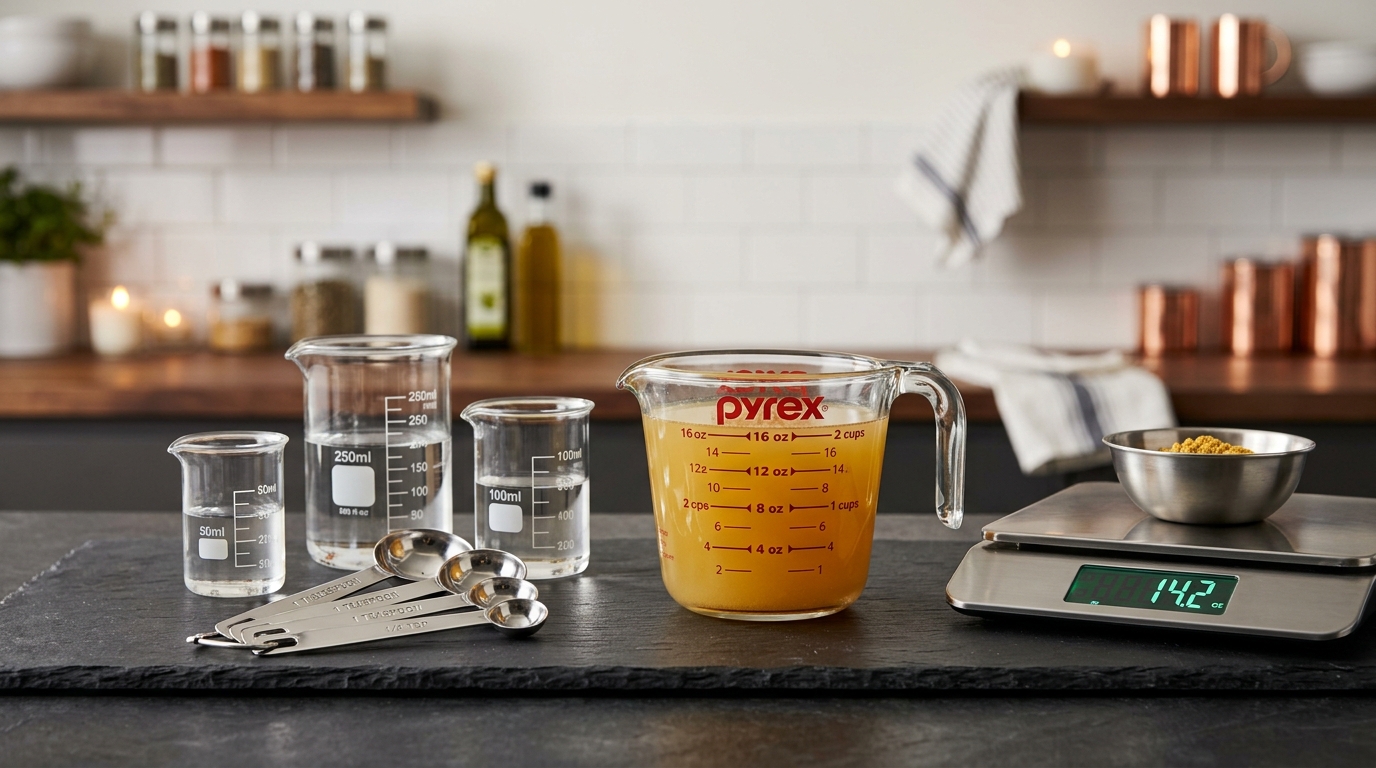
Executive Summary
In American cooking, one standard cup contains exactly 8 fluid ounces. That equals 16 tablespoons, 48 teaspoons, and 236.59 milliliters. Fluid ounces measure liquid capacity, while dry ounces measure scale mass. For pure room temperature water, 8 fluid ounces happens to weigh 8.35 avoirdupois ounces. This similarity creates a convenient mental rule, yet applying it to flour, oils, or honey causes major recipe failures. One cup of sifted all-purpose flour weighs around 4.25 ounces, while one cup of clover honey weighs 12 ounces. This reference guide details exact conversion ratios between metric milliliters, US customary fluid ounces, dry weight ounces, and common kitchen scoops. You can use our rapid mL to ounces converter and our density calculator to verify any ingredient before cooking.
Interactive Cooking Measurement & Ounce Calculator
Select any common kitchen measurement and ingredient to calculate instant fluid ounces, weight ounces, and metric equivalents.
Understanding Ounces in Cooking
Cooking relies on accurate measurement to trigger predictable chemical reactions. When a recipe simply states ounces, confusion between volume and mass often ruins the result.
What Does an Ounce Mean in Cooking?
In cooking, the word ounce describes two distinct measurements: volume and physical weight. Liquid recipes mean fluid ounces (fl oz) to measure volume. Baking and dry goods specify avoirdupois ounces (oz) to measure mass on a kitchen scale. Confusing these units alters dough hydration and seasoning balance.
Fluid Ounces vs Weight Ounces
Fluid ounces measure container capacity, where one US fluid ounce equals 29.57 milliliters of space. Weight ounces measure mass under gravity, where one dry ounce equals 28.35 grams. Water is the only ingredient where fluid ounces and weight ounces almost match. Eight fluid ounces of water weighs roughly 8.35 ounces on a scale. Applying that assumption to dry flour or oils causes recipe failure, as explained in our liquid density guide.
Visual Comparison: 8 Fluid Ounces (1 Cup) Across Different Ingredients
When to Use Fluid Ounces for Liquid Ingredients
Use fluid ounce measuring tools for pourable liquids like water, milk, stocks, wine, and vinegars. For viscous ingredients like honey or molasses, weighing directly on a digital scale avoids residue left on cup walls.
Common mL to Ounce Cooking Conversions
One United States fluid ounce contains 29.57 milliliters. Domestic cooks frequently round this figure to 30 mL for daily cooking. Below are exact culinary conversions.
5 mL to Ounces
Five milliliters equals 0.169 US fluid ounces, matching one level teaspoon. When adding vanilla or citrus extracts, 5 mL provides the standard flavor baseline.
15 mL to Ounces
Fifteen milliliters converts to 0.507 US fluid ounces, representing one half fluid ounce. In daily cooking, 15 mL equals one level tablespoon or three teaspoons.
30 mL to Ounces
Thirty milliliters equals 1.014 US fluid ounces. Cooks treat 30 mL as the standard single fluid ounce, matching two tablespoons or one eighth of a cup.
60 mL to Ounces
Sixty milliliters equals 2.029 US fluid ounces, representing one quarter cup or four level tablespoons.
120 mL to Ounces
One hundred twenty milliliters equals 4.058 US fluid ounces, matching one half cup or eight tablespoons.
250 mL to Ounces
Two hundred fifty milliliters equals 8.454 US fluid ounces, defining the standard metric cup in Australia, New Zealand, and Canada.
500 mL to Ounces
Five hundred milliliters equals 16.907 US fluid ounces. This volume equals two metric cups and slightly exceeds one US liquid pint (16 fl oz).
1 Liter to Ounces
One liter equals 1,000 milliliters and converts to 33.814 US fluid ounces, representing 4.23 US cups or 1.057 US quarts.
Cooking Measurement Conversion Chart
The tables below connect milliliters, fluid ounces, and common kitchen scoops into an easy reference system for quick meal preparation.
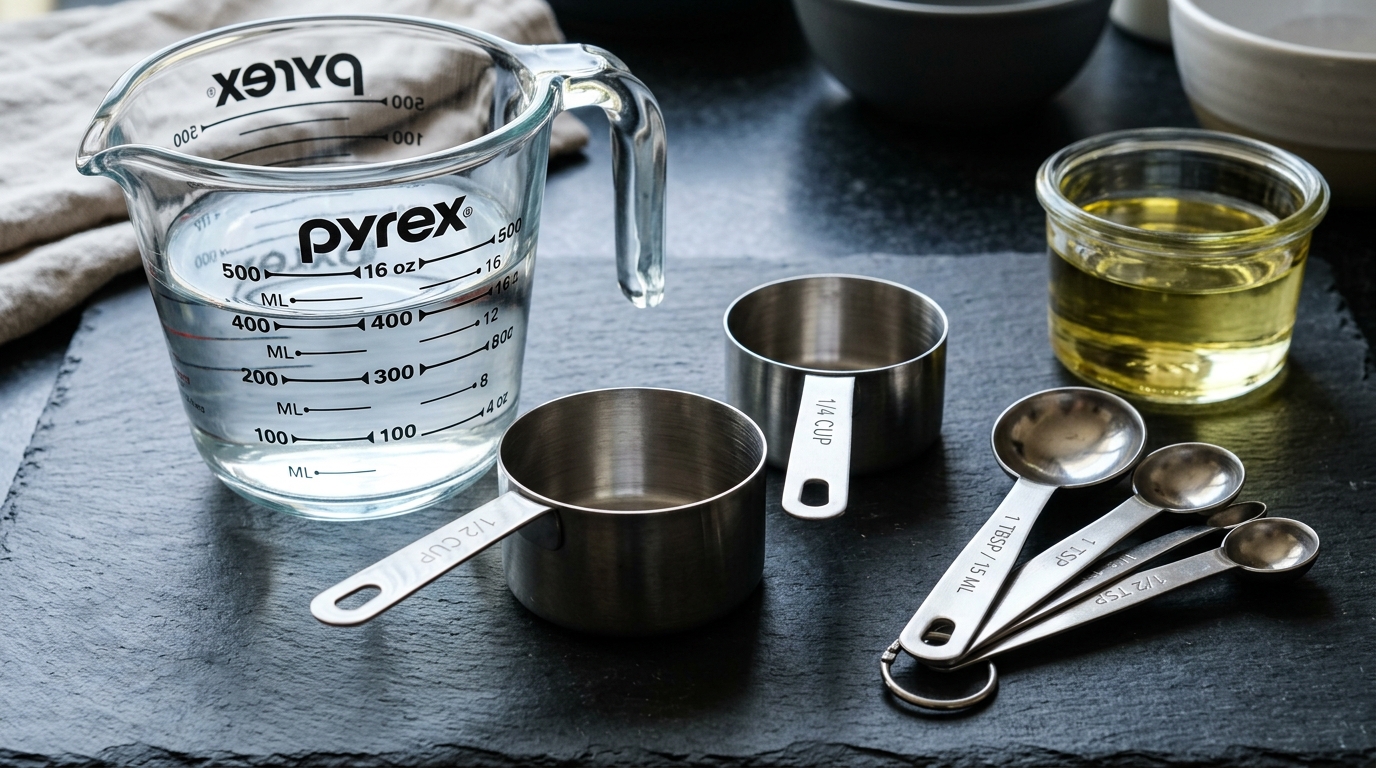 Figure 1: Standard kitchen measuring vessels alongside graded liquid glassware and prep ingredients.
Milliliters to Fluid Ounces
The table below presents standard metric volumes converted into US fluid ounces alongside practical kitchen equivalents.
Table 1: Milliliter to Fluid Ounce Conversion
| Volume (mL) | Exact US Fl Oz | Rounded Fl Oz | Kitchen Measurement Equivalent |
|---|---|---|---|
| 5 mL | 0.169 fl oz | 0.17 fl oz | 1 Level Teaspoon |
| 10 mL | 0.338 fl oz | 0.34 fl oz | 2 Level Teaspoons |
| 15 mL | 0.507 fl oz | 0.50 fl oz | 1 Level Tablespoon (3 tsp) |
| 30 mL | 1.014 fl oz | 1.00 fl oz | 2 Tablespoons (1/8 Cup) |
| 60 mL | 2.029 fl oz | 2.00 fl oz | 4 Tablespoons (1/4 Cup) |
| 120 mL | 4.058 fl oz | 4.00 fl oz | 8 Tablespoons (1/2 Cup) |
| 240 mL | 8.115 fl oz | 8.00 fl oz | 1 US Legal Nutrition Cup |
| 250 mL | 8.454 fl oz | 8.45 fl oz | 1 Metric Cup (Commonwealth) |
| 500 mL | 16.907 fl oz | 16.9 fl oz | 2 Metric Cups (1.05 US Pints) |
| 1,000 mL | 33.814 fl oz | 33.8 fl oz | 4.23 US Cups (1.06 US Quarts) |
Cups to Milliliters and Fluid Ounces
American recipes use cup measures for most liquid and dry items. Understanding how each fractional cup matches fluid ounces and milliliters simplifies international recipes.
Table 2: Common Cup Volumes to Ounces and Milliliters
| Cup Measurement | US Fluid Ounces | Tablespoons | Metric Milliliters | Water Scale Weight |
|---|---|---|---|---|
| 1/8 Cup | 1.00 fl oz | 2 tbsp | 29.57 mL | 1.04 oz wt (29.6 g) |
| 1/4 Cup | 2.00 fl oz | 4 tbsp | 59.15 mL | 2.09 oz wt (59.2 g) |
| 1/3 Cup | 2.67 fl oz | 5.33 tbsp | 78.86 mL | 2.78 oz wt (78.9 g) |
| 1/2 Cup | 4.00 fl oz | 8 tbsp | 118.29 mL | 4.17 oz wt (118.3 g) |
| 2/3 Cup | 5.33 fl oz | 10.67 tbsp | 157.73 mL | 5.57 oz wt (157.7 g) |
| 3/4 Cup | 6.00 fl oz | 12 tbsp | 177.44 mL | 6.26 oz wt (177.4 g) |
| 1 Cup | 8.00 fl oz | 16 tbsp | 236.59 mL | 8.35 oz wt (236.6 g) |
| 1 Pint | 16.00 fl oz | 32 tbsp | 473.18 mL | 16.69 oz wt (473.2 g) |
Tablespoons to Milliliters and Fluid Ounces
Tablespoons connect small teaspoon quantities to fractional cups. One tablespoon equals 0.50 fluid ounces and 14.79 milliliters (rounded to 15 mL). Six tablespoons of olive oil equals exactly 3.0 fluid ounces or 90 mL. You can check our guide on cups in a pint to see how tablespoons scale into larger batches.
Teaspoons to Milliliters and Fluid Ounces
Teaspoons measure spices, leaveners, and concentrated extracts. Three level teaspoons make one tablespoon, and 48 teaspoons equal one standard cup. One teaspoon contains 0.167 fluid ounces and 4.93 milliliters. Always use calibrated measuring spoons rather than tableware to protect dough chemistry.
How Many mL Are in Common Kitchen Measurements?
European blogs and pastry books specify liquids in milliliters. Translating American measuring sets to metric units requires five fundamental values.
How Many mL Are in a Teaspoon?
A standard US teaspoon contains 4.93 mL, rounded to 5.0 mL in culinary and medical practice. When measuring baking powder or vanilla, 5 mL provides an exact baseline.
How Many mL Are in a Tablespoon?
A US tablespoon holds 14.79 mL, rounded to 15 mL. UK and Canadian tablespoons also equal 15 mL. In Australia, a traditional tablespoon contains 20 mL, comprising four teaspoons.
How Many mL Are in a Cup?
A US Customary cup contains 236.59 mL. US nutrition labels use a legal cup rounded to 240 mL. Commonwealth metric cups hold 250 mL.
How Many mL Are in a Half Cup?
One half US Customary cup holds 118.29 mL, rounded to 120 mL in home kitchens. This volume matches 8 tablespoons or 4 fluid ounces.
How Many mL Are in a Quarter Cup?
One quarter cup holds 59.15 mL, rounded to 60 mL in kitchen practice, equaling four tablespoons or two fluid ounces.
Kitchen Volume Hierarchy: Teaspoon to Pint Ratios
How Many Ounces Are in Common Cup Measurements?
American baking tools rely on nesting cups and graduated liquid jugs. Memorizing the capacity of each fractional cup prevents cooking interruptions.
1/4 Cup to Ounces
One quarter cup contains exactly 2.0 fluid ounces, holding four tablespoons or 12 teaspoons.
1/3 Cup to Ounces
One third cup contains 2.67 fluid ounces, holding 5 tablespoons plus one teaspoon (78.86 mL).
1/2 Cup to Ounces
One half cup holds 4.0 fluid ounces (8 tablespoons). One standard stick of butter equals one half cup, weighing 4.0 dry ounces.
2/3 Cup to Ounces
Two thirds cup holds 5.33 fluid ounces, equaling 10 tablespoons plus two teaspoons (157.7 mL).
3/4 Cup to Ounces
Three quarters cup contains 6.0 fluid ounces, matching 12 tablespoons or 177.44 mL.
1 Cup to Ounces
One standard US cup holds 8.0 fluid ounces (16 tablespoons and 236.59 mL). One cup of water weighs 8.35 avoirdupois ounces. See our mL to grams converter for mass calculations.
How to Convert Recipe Measurements Between mL and Ounces
Translating recipes across measurement systems requires dependable conversion formulas to ensure accurate dough hydration.
Converting a Metric Recipe to US Measurements
To convert milliliters to US fluid ounces, divide milliliters by 29.57. For quick estimates, dividing by 30 provides a practical number.
Converting US Measurements to Metric
To convert US fluid ounces to metric milliliters, multiply fluid ounces by 29.57. Four fluid ounces multiplied by 29.57 yields 118.3 mL.
Scaling a Recipe Up or Down
When scaling recipes, convert all ingredients into milliliters or grams first, multiply or divide, and then convert back into cups or spoons to avoid fractional errors.
US, Metric, and UK Cooking Measurements
English speaking regions use similar culinary terms that hold different liquid capacities.
US Cups vs Metric Cups
An American Customary cup holds 236.59 mL (8.0 US fl oz). The Commonwealth metric cup holds 250 mL (8.45 US fl oz). Use our density to volume converter when adapting foreign baking recipes.
US Fluid Ounces vs UK Fluid Ounces
The British Imperial fluid ounce equals 28.41 mL, slightly smaller than the US fluid ounce at 29.57 mL. However, a British Imperial pint contains 20 fluid ounces (568.26 mL), twenty percent larger than an American pint (473.18 mL).
US Tablespoons vs UK Tablespoons
In the US, Canada, and UK, one tablespoon equals 15 mL (three 5 mL teaspoons). In Australia, a tablespoon equals 20 mL, containing four teaspoons.
International Volume Standards Comparison (Capacity in mL)
Common Cooking Ingredients Measured in mL and Ounces
Density determines how volume translates to mass. Equal fluid ounce volumes of different ingredients produce different scale weights.
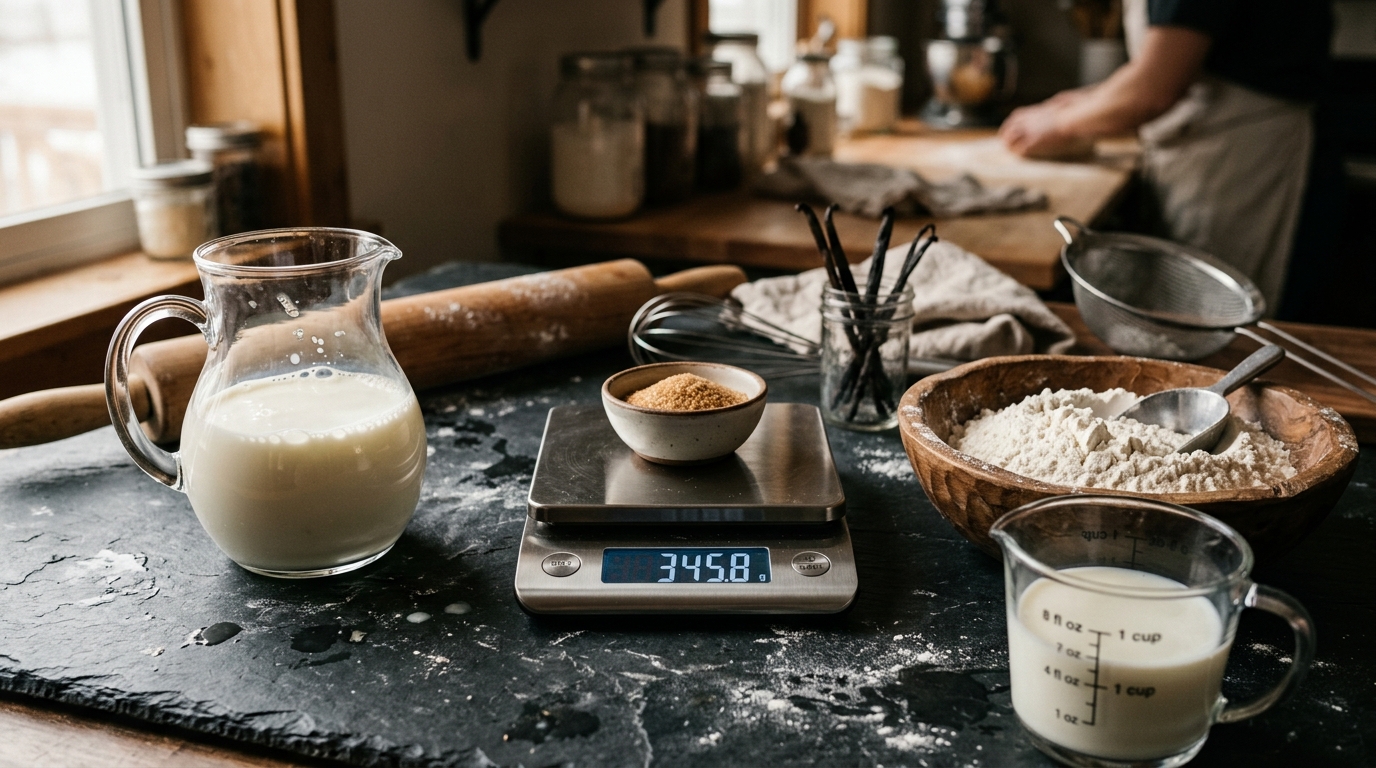 Figure 2: Digital kitchen scale verifying weight differences across liquid dairy and baking staples.
Water and Other Liquids
Tap water has a density of 1.000 g/mL. Clear broths, dry wines, and vinegars share this density closely, meaning one cup (8 fluid ounces) weighs 8.35 avoirdupois ounces (236.6 grams).
Milk and Cream
Whole milk has a density of 1.032 g/mL, weighing 8.62 weight ounces per cup. Heavy cream sits near 1.010 g/mL, weighing 8.44 ounces per cup. Check our liquid density lookup database for complete tables.
Oils and Sauces
Cooking oils float on water with densities around 0.92 g/mL. One cup of olive oil weighs only 7.66 weight ounces (217.2 grams). Measuring oil by weight instead of volume can add excess fat to doughs.
Syrups and Other Liquid Ingredients
Clover honey has a density of 1.420 g/mL, and pure maple syrup measures 1.370 g/mL. One cup of honey weighs 11.85 weight ounces (336 grams). Weighing syrups directly on a scale avoids measuring cup loss.
Common Mistakes When Converting Cooking Measurements
Recognizing common measurement traps helps you maintain consistent texture and flavor in your cooking.
Confusing Fluid Ounces With Weight Ounces
Assuming an eight ounce bag of shredded cheese fills an 8 fluid ounce cup creates large errors. One cup of shredded cheese weighs 4 ounces, meaning an 8 ounce bag fills two full cups.
Mixing US and UK Measurements
Using American cups (236.6 mL) for British recipes (250 mL) shortchanges liquid content. Over four cups of broth, this causes a 53 mL shortage.
Rounding Conversion Values
Rounding 29.57 mL to 30 mL works for small dressings, but multiplying rounded values across catering batches shifts volume by over one quart. Use our common mL to kg guide for large batches.
Using Volume Measurements for Solid Ingredients
Scooping dry flour into volume cups causes up to forty percent variation based on compaction. Weighing dry goods on a kitchen scale ensures consistent bakes.
mL to Ounces Cooking FAQs
How Many Ounces Are in 15 mL?
Fifteen milliliters contains 0.507 US fluid ounces. Cooks treat 15 mL as one half fluid ounce, equal to one level tablespoon or three teaspoons.
How Many Ounces Are in 30 mL?
Thirty milliliters contains 1.014 US fluid ounces. In culinary and beverage prep, 30 mL serves as one standard fluid ounce or two tablespoons.
How Many Ounces Are in 100 mL?
One hundred milliliters equals 3.381 US fluid ounces. In domestic measures, this equals 6 tablespoons plus 2 teaspoons, or roughly 0.42 cups.
How Many Ounces Are in 250 mL?
Two hundred fifty milliliters equals 8.454 US fluid ounces. It defines one legal metric cup in Australia, New Zealand, and the United Kingdom.
How Many Ounces Are in 500 mL?
Five hundred milliliters equals 16.907 US fluid ounces. This volume equals two metric cups, slightly exceeding one American liquid pint (16 fl oz).
How Many Ounces Are in 1 Liter?
One liter equals 33.814 US fluid ounces. In kitchen volumes, one liter represents 4.23 US cups or 1.057 US liquid quarts.
Is 1 Cup the Same as 8 Ounces?
One US cup is always 8 fluid ounces of volume. It only equals 8 weight ounces if the ingredient shares the exact density of water.
Is a Tablespoon the Same as 15 mL?
In the United States, Canada, and the UK, one tablespoon equals 15 mL (14.79 mL exact). In Australia, a legal tablespoon is 20 mL.
Is a Teaspoon the Same as 5 mL?
Yes, a cooking teaspoon is universally treated as 5 mL. Exact US customary teaspoons hold 4.93 mL, rounded to 5.0 mL in recipes.
Can I Use a mL to Ounces Calculator for Recipes?
Yes, digital converters calculate liquid volumes rapidly without rounding mistakes. Use our mL to ounces calculator for instant recipe conversions.